Single Operator Basement Contractor vs. a Big Remodeling Company: How to Choose
You have decided to finish the basement. Now you are staring at two kinds of bids: one from a single operator basement contractor who answers his own phone, and one from a larger remodeling company with a showroom, a sales rep, and a project manager you have not met yet. Both can build you a finished basement. They will not do it the same way, and the differences matter more than the logo on the truck.
This guide walks you through how to compare the two, step by step, so you end up with a basement bedroom, playroom, or family room that feels like it was always part of the house, built by someone who will still be reachable in month three.
Step 1: Understand What Each Type of Contractor Actually Is
Before you compare bids, know who you are comparing. A single operator basement contractor is one person who runs the business, sells the job, and manages or performs the work. He may swing the hammer himself or run a small crew, and he brings in licensed electricians and plumbers for the trades that require their own licensing.
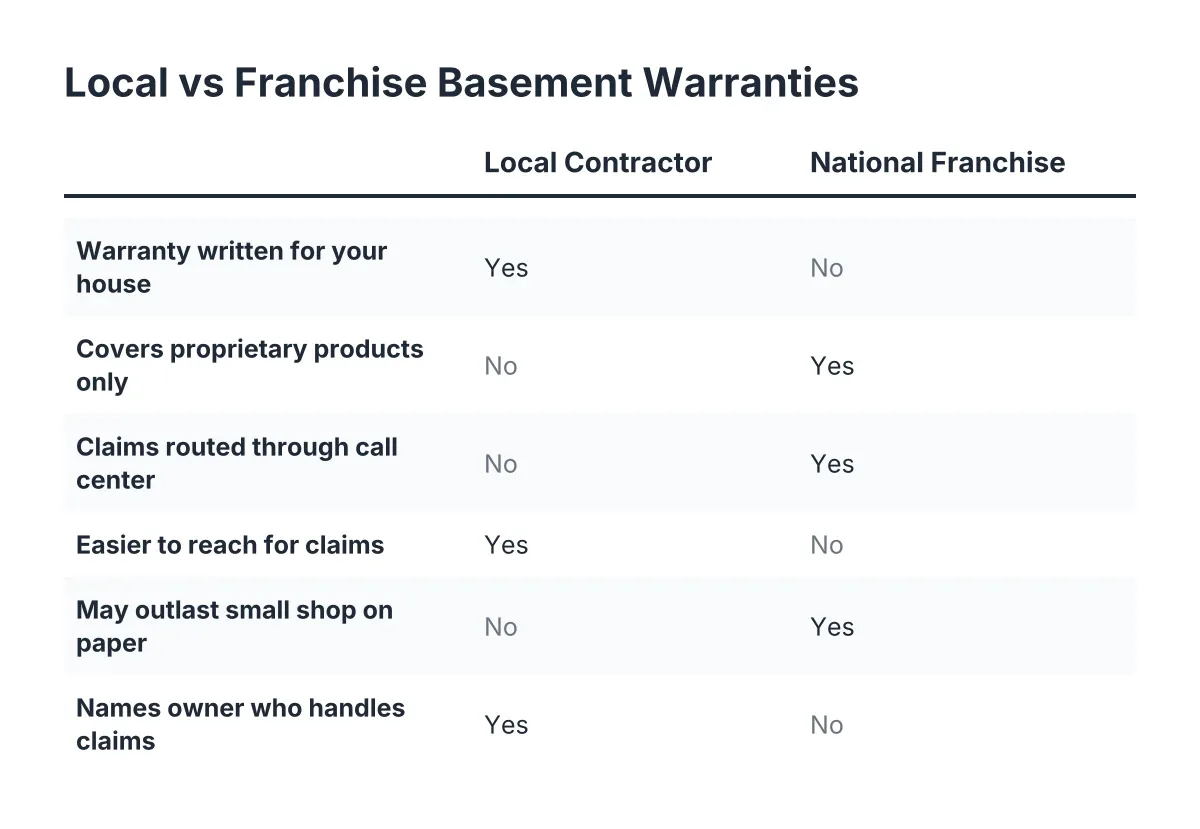
A larger remodeling company splits those roles. A salesperson quotes the job, a project manager schedules it, and crews rotate through. Some of the biggest names in basement remodeling in Minneapolis are franchise networks. They route your lead to whoever is on call and build with a standardized wall and floor system, whether or not that system fits your 1950s block foundation and its specific moisture history.
Neither model is automatically better. However, they fail in different ways, and you should know which failure you can live with.
Why a Single Operator Basement Contractor Works Differently in Minneapolis
Minneapolis basements are not generic. Freeze-thaw cycles, older foundations, and real moisture conditions mean the person designing your layout should know local basements, not a national playbook. A standardized franchise system can work fine in a dry basement. In a basement with a seasonal damp corner, you want someone who walks the space, finds the problem, and plans around it before drywall goes up.
Step 2: Weigh the Pros and Cons of a Single Operator Basement Contractor
Start with the honest trade-offs on the small-operator side, because this is where most homeowners have the biggest questions.
The advantages are real:
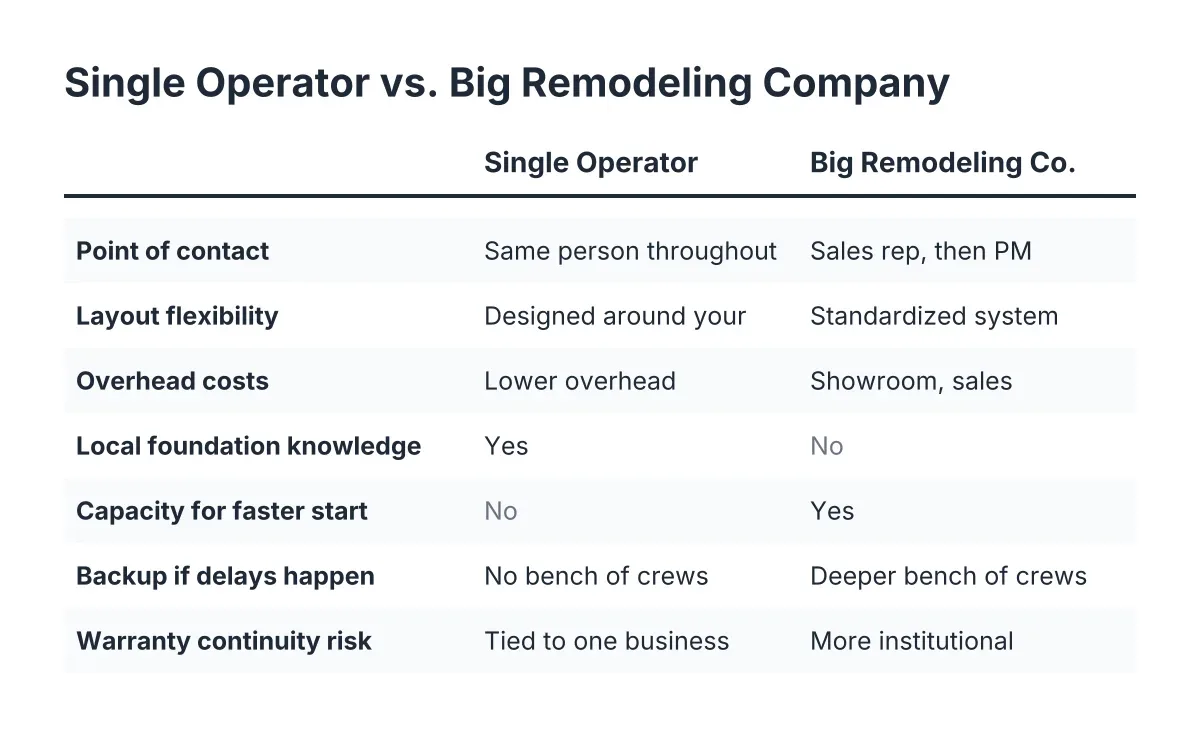
- One point of contact. The person who quoted your basement is the person building it. Nothing gets lost between sales and production.
- Flexibility on layout. No standardized product system means your basement layout gets designed around your family, your mechanicals, and your foundation, not around a franchise catalog.
- Lower overhead. No showroom, no sales commissions, no franchise fees baked into your price. That does not make the work cheap, but you are paying for labor and materials, not marketing.
- Local knowledge. A local operator who has opened up dozens of Minneapolis basements knows what moisture, old wiring, and low-clearance ductwork look like before demo starts.
The trade-offs are just as real:
- Capacity. One operator can only run so many jobs. If he is booked, your start date may be further out than a company with five crews.
- Schedule risk. If the operator gets sick or a prior job runs long, there is no bench of crews to backfill. Ask how he handles delays before you sign.
- Continuity. If the business closes, warranty support goes with it. Get the warranty in writing and ask what it covers, for how long.
Larger companies flip those lists. They offer faster starts and deeper benches, but you trade away the direct relationship, pay for the overhead, and often get a one-size-fits-most system instead of a design built for your house.
Step 3: Check the Credentials That Apply to Both
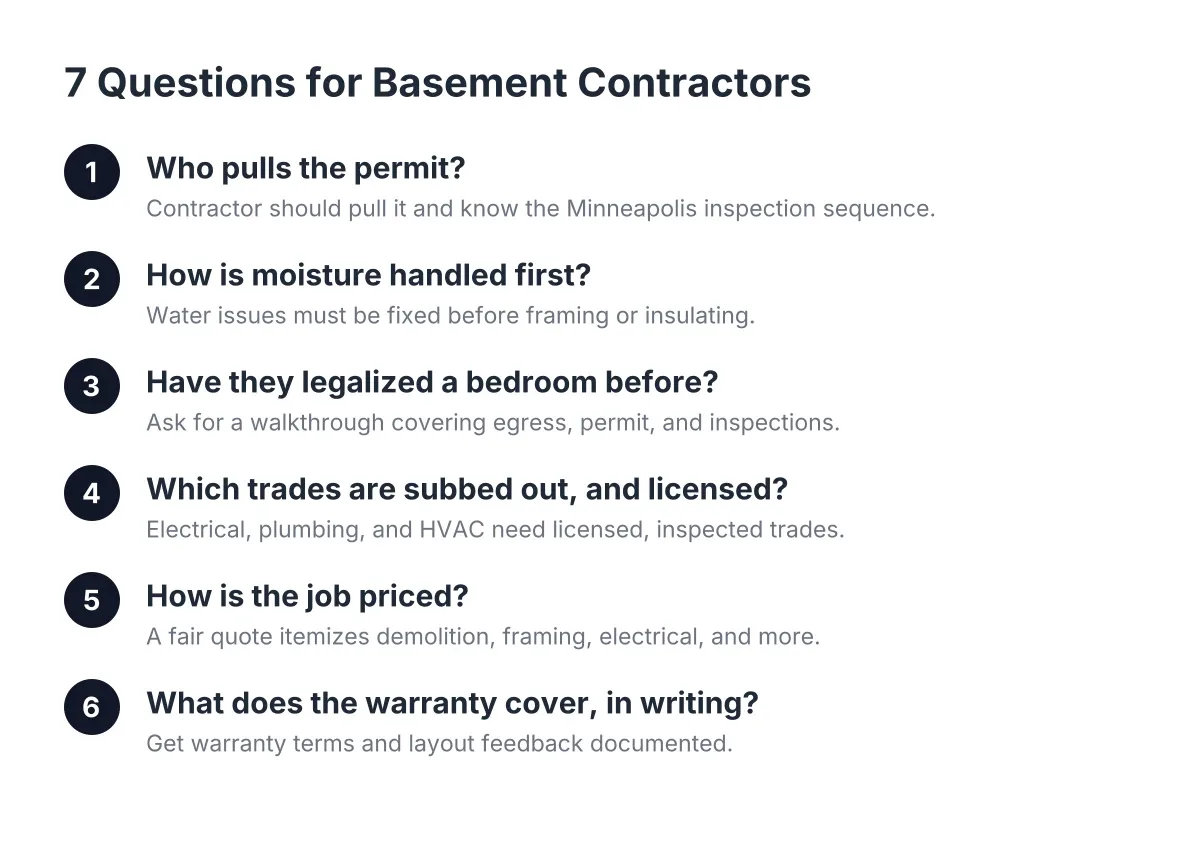
Whichever direction you lean, the baseline does not change. Verify that the contractor is licensed and insured in Minnesota before you compare anything else. Ask for proof, not a verbal yes.
In addition, ask who handles the specialty trades. Even a skilled single operator should bring in a licensed electrician and a licensed plumber for the basement bathroom rough-in and the new circuits. If someone tells you they personally handle all trades without those licenses, that is a red flag regardless of company size.
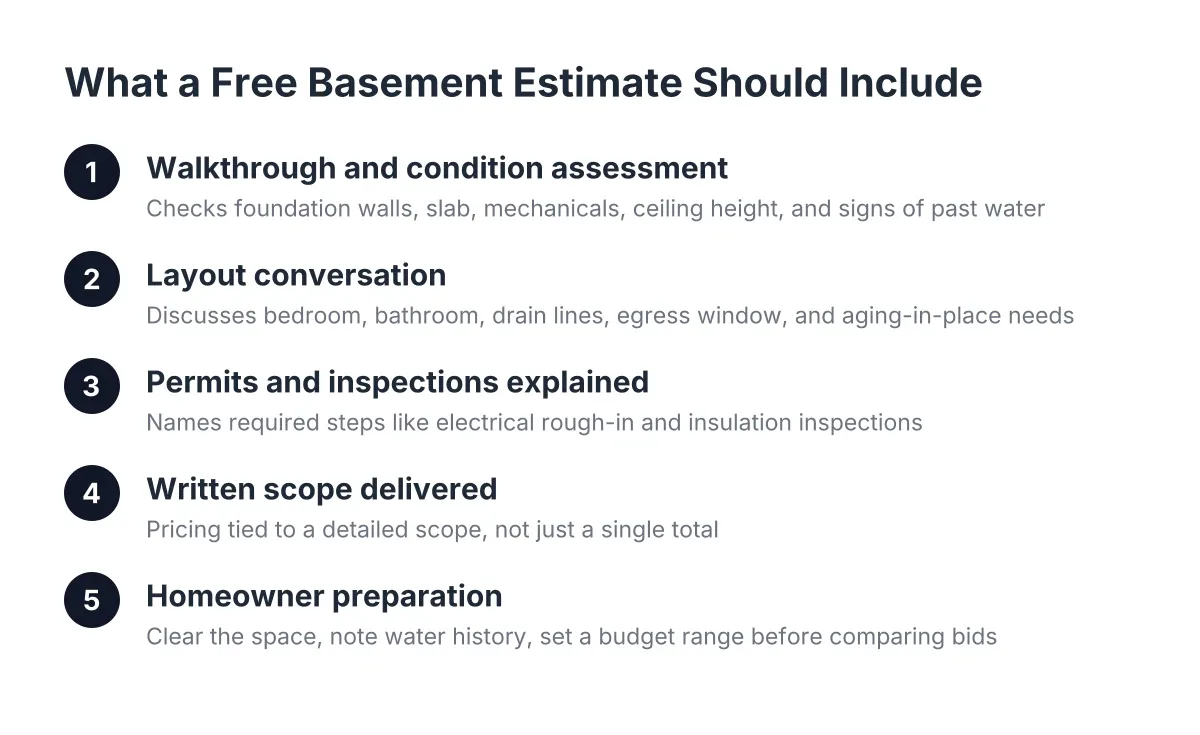
Permits matter just as much. A finished basement in Minneapolis needs permits and inspections, including an electrical rough-in inspection and a separate insulation inspection before drywall. A contractor of any size who suggests skipping permits is telling you how the rest of the job will go.
Step 4: Get Quotes You Can Actually Compare
Next, get at least two or three written estimates and make them answer the same questions. A fair basement finishing quote spells out scope, not just a bottom-line number. Look for:
- Square footage and a rough layout, including any bedroom, bathroom, or egress work.
- What is included: framing, insulation, drywall, flooring, trim, paint, and fixtures.
- What is excluded or allowance-based, like flooring material or bathroom tile.
- Who pulls permits and schedules inspections.
- Payment schedule tied to milestones, not a huge deposit up front.
For budgeting context, an average basement remodel runs between $30 and $75 per square foot, with high-end projects exceeding $120 per square foot, according to Angi. If one bid lands far below that range, ask what was left out. Underestimated trim work is a common gap; a finished basement carries far more baseboard, casing, and paneling than most homeowners expect, and thin bids often skip it.
How a Single Operator's Quote Reads Differently
Expect the single-operator bid to be less polished and more specific. A franchise quote may arrive as a glossy package priced per linear foot of wall system. The local operator's quote should read like your actual basement: this wall moves here, this corner needs moisture treatment first, this flooring works over your slab. Specificity is the tell. A quote that could describe any basement in the metro was not written for yours.
Step 5: Run One Real-World Test Before You Sign
Suppose you are a Minneapolis homeowner with two kids, a pre-approved home equity loan, and an unfinished basement you want to turn into a bedroom and family room. Ask each bidder the same question: where would you put the bedroom, and why? In that scenario, the answer tells you everything.
A strong local answer references your furnace location, your window positions, your ceiling height, and where moisture has shown up. A weak answer defaults to a standard floor plan. The same test works if you are an empty nester planning a guest suite for an aging parent; ask how they would design the space for single-level comfort downstairs, and listen for specifics about your house.
This is also the stage where hiring a basement contractor stops being about price and becomes about fit. Local basement remodelers who ask more questions than they answer in the first meeting usually produce better finished basements, because the design problems get solved on paper instead of mid-drywall.
Step 6: Decide Based on Your Project, Not the Pitch
Finally, match the contractor type to the job in front of you. As a rule of thumb:
- Choose a single operator basement contractor when your basement has quirks, you want a custom layout, you value one accountable person, and your timeline has some flexibility.
- Choose a larger company when you need a firm fast start date, your basement is dry and straightforward, and you are comfortable with a standardized system and a rotating cast of contacts.
Keep expectations honest either way. Basement finishing recovers 64% of its cost at resale, one of the highest rates among 20 common remodeling projects, according to the National Association of Realtors. The bigger payoff is how you live; homeowners rated basement finishing a 9.5 out of 10 joy score in the same NAR report. If you are finishing the basement to stay in your school district instead of moving, that is the return that counts.
One limitation worth naming: if your basement shows active water intrusion, standing water, or foundation cracks, stop the remodel conversation and bring in a waterproofing or structural professional first. No contractor, large or small, should finish over an unresolved water problem.
The Bottom Line for Minneapolis Homeowners
Searching for a basement remodeling service near me will surface franchise networks first, because they spend the most on ads. Dig one layer deeper. Compare at least one local, single-operator bid against the big-company quote, run both through the steps above, and pick the one whose plan was clearly written for your basement.
If you are in Minneapolis or the surrounding area and want a straight answer on your layout, flooring, and permits before any work begins, reach out for a free estimate. Walking the space together is the fastest way to find out what your basement can become.
If you need basement finishing, Minneapolis Basement Finishing Pros can help.
Prefer to talk it through? Call (651) 758-8806 — a quick call is usually the fastest way to get a straight answer for your situation.