How to Vet Basement Contractors: Licenses, References, and Insurance in Minneapolis, MN
Before you sign a contract for basement finishing, you need a way to separate a solid local crew from a franchise call center or a fly-by-night operator. The most reliable way to do that is to vet basement contractors' licenses, references, and insurance before any money changes hands. This guide walks homeowners in Minneapolis, MN through the steps of vetting basement contractors so you know exactly what to check, what to ask, and which answers should send you looking elsewhere.
This matters more with basements than with most projects. A finished basement done right adds real living space; the National Association of Realtors Remodeling Impact Report found homeowners gave basement finishing a joy score of 9.5 out of 10, and that 64% of the cost is recovered at sale, one of the highest percentages among 20 popular projects studied. A basement done wrong hides moisture problems behind drywall and turns into a tear-out. Vetting is how you land on the right side of that line.
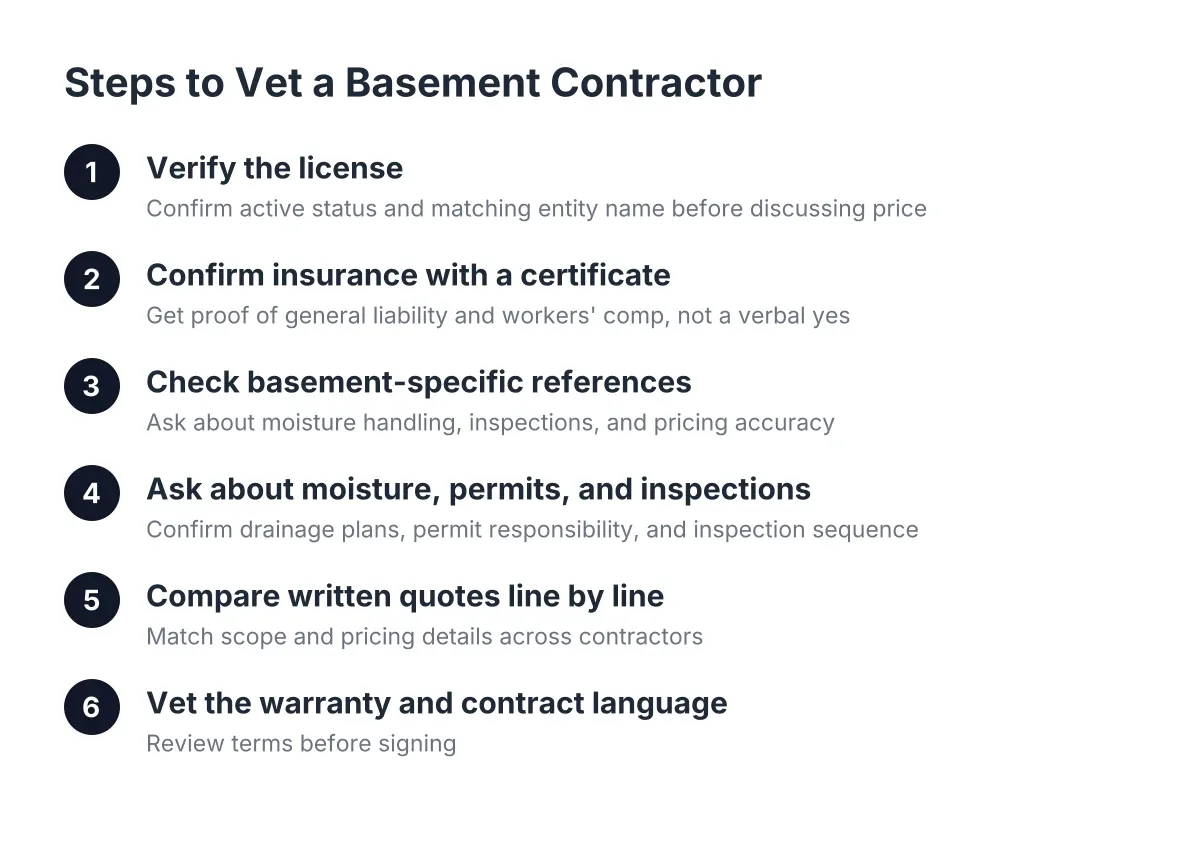
Step 1: Verify the Contractor's License Before You Talk Price
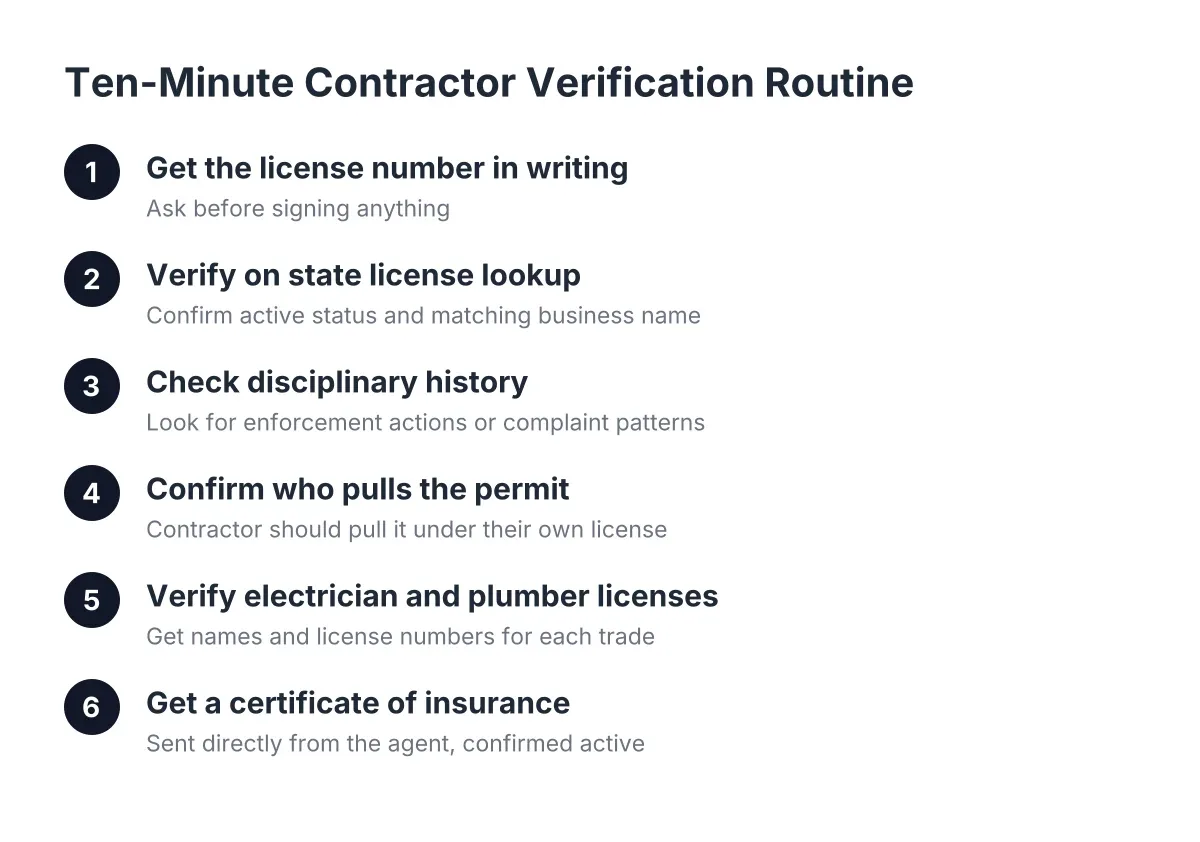
Start with the license, because it filters out the worst options fast. In Minnesota, residential contractors are licensed at the state level, and you can look up any contractor's license status yourself through the Minnesota Department of Labor and Industry's public lookup. Do not take a business card or a website badge as proof. Search the actual name of the business, not the salesperson's name.
When you vet basement contractors, licenses should match the entity on your contract. If the quote comes from "Smith Basements LLC" but the license belongs to a different company name, ask why before you go further. Some franchise networks license one entity and route your job to whoever is available; you want to know who actually holds legal responsibility for your basement.
Here is what to confirm at this step:
- The license is active, not expired or suspended
- The licensed name matches the name on the written estimate
- There are no unresolved enforcement actions on record
- Subcontractors for electrical and plumbing hold their own trade licenses
That last point matters. Even contractors who do their own framing and drywall should bring in a licensed electrician for wiring and a licensed plumber for a basement bathroom. Those trades require separate licensing for a reason, and a contractor who shrugs that off is telling you how they treat inspections too.
Step 2: Confirm Insurance With a Certificate, Not a Verbal Yes
Ask every contractor for a certificate of insurance showing general liability coverage and workers' compensation. Do not accept "yes, we're covered" over the phone. A legitimate contractor can have their insurance agent send you the certificate directly, usually within a day.
Why does this matter for a basement finish? Suppose a worker gets hurt cutting into your slab, or a plumbing mistake floods your utility room and the finished space above it. Without proper coverage, those costs can land on you as the homeowner. Licensed and insured is the baseline, not a bonus feature.
For small landlords finishing basements in a duplex or rental, this step carries extra weight. Your liability exposure includes tenants, and your insurance carrier may ask who did the work if a claim ever comes up. Keep the certificate with your project file.
Step 3: Check References From Basement Jobs, Not Just Any Jobs
References only help if they match your project. A contractor with glowing reviews for decks tells you nothing about how they handle a basement bathroom rough-in or a damp slab. Ask for two or three references from finished basement projects in Minneapolis and the surrounding area, ideally completed at least a year ago so any moisture problems have had a winter to show up.
When you call, ask specific questions:
- Did the crew find moisture issues, and how did they handle them?
- Did the project pass electrical and insulation inspections on the first try?
- Did the final price match the written estimate, and if not, why?
- Did the same people who quoted the job actually run it?
- Would you hire them again for another basement?
That fourth question exposes a common franchise pattern. National basement-finishing networks often send a polished salesperson, then hand your job to whichever installer is on call. A local operation quotes the job with the people who will build it. Neither model is illegal, but you deserve to know which one you are buying.
Step 4: Essential Steps When Vetting Basement Contractors on Moisture, Permits, and Inspections
A trustworthy basement contractor talks about moisture before they talk about flooring samples. Minneapolis basements deal with real ground moisture, and any contractor who wants to insulate and drywall without first addressing drainage and dampness is setting up a failure. Insulating over unresolved moisture problems can degrade the structure fast, and by the time you see it, the finished surfaces are already ruined.
Ask each contractor these questions directly:
- How will you check my slab and walls for moisture before framing?
- What happens if you find damp spots after demo?
- Who pulls the permits, you or me?
- Which inspections does this project require, and when do they happen?
On that last question, listen for specifics. A typical basement finish in Minneapolis involves an electrical rough-in inspection early on and an insulation inspection later, before drywall goes up. A contractor who can walk you through that sequence has done this in this city. Additionally, a contractor who says "we don't usually need permits for basements" should be crossed off your list; unpermitted work can stall a future sale and leaves you with no inspection record.
One honest limitation: no contractor can promise your basement is moisture-proof forever. Even a slab with a vapor barrier underneath can benefit from a subfloor system that protects the finished space from a future water event. Good contractors explain that trade-off instead of hiding it.
Step 5: Compare Written Quotes Line by Line
Get at least three written estimates before you decide. As of 2026, an average basement remodel runs between $30 and $75 per square foot according to Angi, with high-end projects exceeding $120 per square foot. If your basement needs an egress window for a legal bedroom, HomeGuide data puts that at $3,000 to $7,000 on average. Use those ranges as a sanity check, not a target.
Say a family in Minneapolis wants to turn 800 square feet of unfinished basement into a bedroom, a playroom, and a small bathroom. In that hypothetical scenario, quotes might land anywhere from the mid twenty thousands to well past sixty thousand depending on the bathroom, the egress window, and the flooring. The number alone tells you little. What the number includes tells you everything.
Compare each quote for:
- Permit fees and who pays them
- Egress window work, if a bedroom is planned
- Bathroom rough-in and fixtures, itemized
- Flooring type and any subfloor system
- Allowances, and whether they are realistic or lowballed
- Payment schedule tied to completed work, not calendar dates
A red flag worth naming: the too-low bid with a big deposit. Hiring a basement contractor who demands half the money up front and offers a vague one-page quote is how homeowners end up with a half-finished basement and a disconnected phone number. Reasonable deposits exist, but the payment schedule should follow the work.
Step 6: Vet the Warranty and the Contract Language
Read the warranty before you sign, because this is where franchise systems and local operators differ most. Franchise networks often warranty their proprietary wall or flooring product, not the workmanship of the crew that installed it. If the installer changes or the territory changes hands, your recourse can get murky. Ask exactly who stands behind the work, in writing, and for how long.
Your contract should also spell out the change-order process. Basements surprise people; demo can reveal old framing with insulation trapped against the concrete, which often needs to come out entirely rather than be built over. A clear contract says how surprises get priced and approved, so a mid-project discovery does not become a mid-project dispute.
For anything structural, or if demo reveals foundation cracks or active water intrusion, bring in the appropriate specialist rather than letting a finishing crew improvise. A good basement contractor will say the same thing.
A Quick Checklist to Vet Basement Contractor Licenses and Credentials
Use this as your final screen before signing:
- License verified through the state lookup, matching the contract name
- Certificate of insurance received directly from the agent
- Trade licenses confirmed for electrical and plumbing subs
- Three basement-specific references called, at least one over a year old
- Moisture plan explained before design talk
- Permits and inspection sequence spelled out in the contract
- Written, itemized quote with a work-based payment schedule
- Warranty covering workmanship, from a named local entity
Most homeowners searching for renovation contractors near me stop at reviews and price. The families who end up happy with their finished basement follow the key steps for vetting basement contractors through the state, and they call references from real basement jobs. It takes an extra afternoon. Compared to living with a bad basement for the next twenty years, that afternoon is the cheapest part of the whole project.
If you need basement finishing, Minneapolis Basement Finishing Pros can help.
Prefer to talk it through? Call (651) 758-8806 — a quick call is usually the fastest way to get a straight answer for your situation.