Basement Contractor Licensing and Insurance in Minneapolis: What to Verify Before Work Starts
You have already decided to hire someone. Maybe the last contractor vanished mid-project, or you bought a house with a half-framed basement the previous owner never finished. Either way, before anyone touches a stud or pulls a wire, you need to verify contractor license insurance. This is the one step that separates a crew you can hold accountable from a crew that can walk away with your deposit. It matters even more in Minneapolis, where national basement-finishing franchises route leads to whoever is on call, and where the person selling the job may never set foot in your basement again after the contract is signed.
This guide walks through exactly what to verify, in what order, and what the paperwork should look like. It is written for someone who has been burned once and does not intend to be burned twice.
Why Licensing and Insurance Come First on a Basement Finish
Licensing and insurance come first because a finished basement touches nearly every regulated trade in a house: framing, electrical, plumbing, insulation, and sometimes structural work around windows. In Minnesota, residential contractors who work in more than one trade generally need a state residential building contractor license. If your contractor cannot show one, everything else about the quote is irrelevant.
Here is the practical reason this matters for you specifically. Say a homeowner in Minneapolis hires an unlicensed crew to finish a basement that was framed by a previous owner. The crew builds on top of framing that was insulated wrong against the concrete, drywalls over it, and leaves. Two winters later there is mold behind the walls. In that scenario, the homeowner has no license board to complain to, no recovery fund to draw from, and an insurance claim that goes nowhere because the "contractor" carried no policy.
Contrast that with a licensed, insured local contractor. The license gives you a state record, a complaint process, and in Minnesota, access to a contractor recovery fund if things go badly wrong. The insurance means that if a worker gets hurt in your basement or the crew floods your furnace room, the loss lands on their policy, not your homeowner's policy.
Basement finishing is also a project people love once it is done right. Homeowners gave basement finishing a joy score of 9.5 out of 10 in the Remodeling Impact Report, according to National Association of Realtors. The same report found 64% of basement finishing costs are recovered at sale, one of the highest returns among the projects studied. That value only holds up if the work is permitted, inspected, and done by someone accountable. An appraiser will not count a basement bedroom finished without permits the same way they count one with a signed-off inspection card.
What Basement Contractor Licensing Should Look Like in Minnesota
A legitimate Minneapolis basement contractor should be able to show you a Minnesota residential building contractor license, in the business name on your contract, in active status. Not "my buddy holds the license." Not "we work under another company's number." The name on the license, the name on the contract, and the name on the insurance certificate should all match.
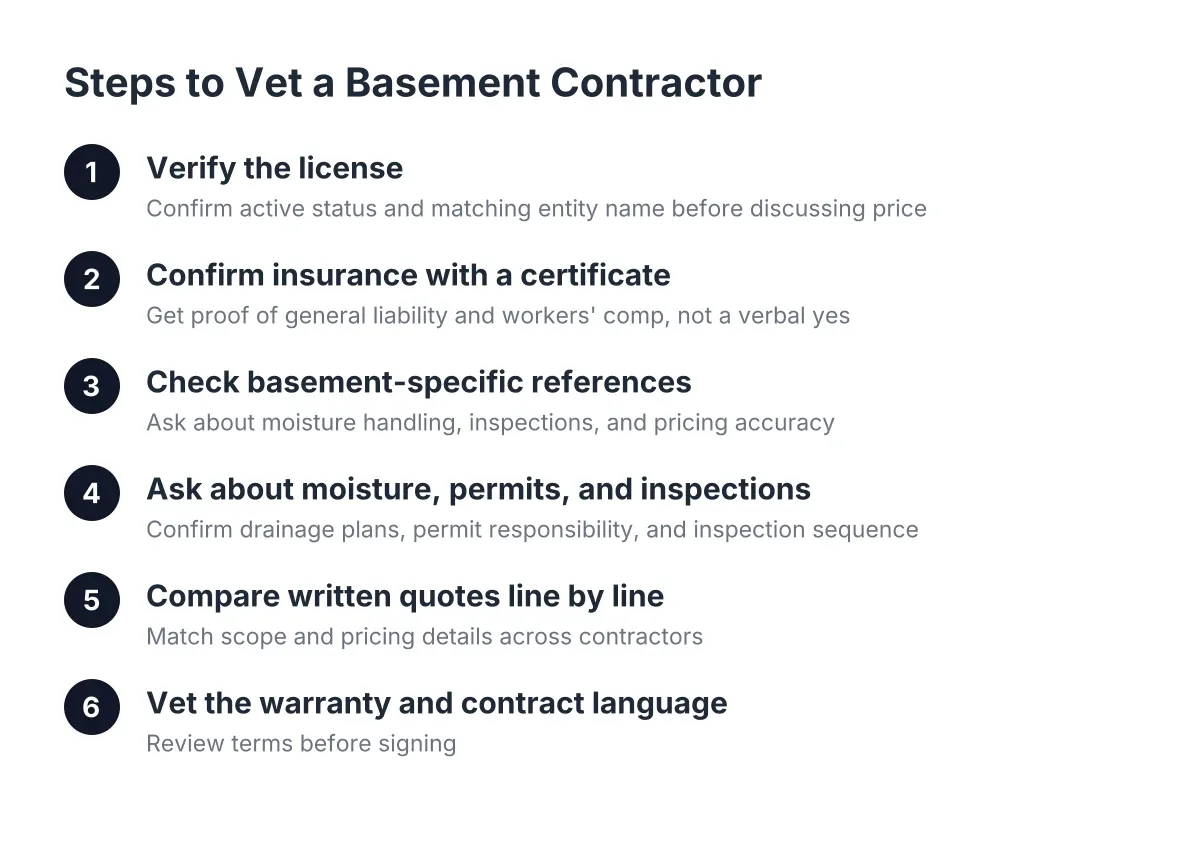
Here is what to check, step by step:
- Ask for the license number in writing before you sign anything. A straightforward contractor will hand it over without hesitation.
- Look it up yourself on the Minnesota Department of Labor and Industry license lookup. Confirm the status is active and the business name matches your contract.
- Check for enforcement actions or disciplinary history on the same lookup. A clean record is not a guarantee, but a pattern of complaints is a clear warning.
- Confirm who pulls the permits. On a basement finish in Minneapolis, the contractor should pull the building permit under their own license, not ask you to pull a homeowner permit while they do the work.
That last point deserves emphasis. When a contractor asks you to pull the permit yourself, you become the responsible party in the city's eyes. Some crews use this move to work without a license while keeping their name off the record. If the job fails inspection, the city calls you, not them.
Trades That Need Their Own Licensing
A basement finish is never just one trade. Electrical work in Minnesota requires a licensed electrician, and plumbing requires a licensed plumber. Your general basement contractor can hold the building license and coordinate the job, but the wiring in your new basement bathroom should be done and signed off by a licensed electrical contractor who pulls their own electrical permit.
This is where half-finished basements get interesting. Suppose the previous owner ran cable through the framing himself before the project stalled. A good contractor will not just build around it. They will have a licensed electrician evaluate what is there, because details matter: for example, non-metallic sheathed cable is not considered best practice for exposed runs, and running it inside EMT conduit is against code in damp or wet locations, according to National Electrical Code (NFPA 70). A basement is exactly the kind of place where that distinction bites. Expect an electrical rough-in inspection early in the project, followed later by an insulation inspection, before any drywall goes up.
Ask directly: who is your electrician, who is your plumber, and are they licensed? A contractor who answers with names and license numbers is running a real operation. A contractor who says "my guys handle everything" is telling you something.
How to Verify Contractor License Insurance
Verifying contractor license insurance means getting a certificate of insurance sent directly from the contractor's insurance agent to you, then confirming the policy is active and covers residential remodeling. A photocopy handed over at the kitchen table proves nothing; policies get canceled for nonpayment all the time, and the paper does not update itself.
There are two coverages that matter on a basement job:
- General liability insurance. This covers damage the contractor causes to your property. If a crew member punctures a supply line and floods your utility room, or drops a beam through your main floor, liability coverage pays. Ask for a policy with limits appropriate for residential remodeling, and confirm the policy is current, not expired.
- Workers' compensation insurance. This covers the crew if someone gets hurt on your property. Basements involve ladders, saws, concrete dust, and awkward stairwells. If an uninsured worker falls on your stairs, the injury claim can land on your homeowner's policy or on you personally.
To verify both, do this: request a certificate of insurance naming you as the certificate holder, sent from the agent's office. Then call the agent listed on the certificate and confirm the policy is in force. Two phone calls, ten minutes, and you have closed the single biggest gap most homeowners leave open.
One honest caveat: even complete, verified contractor license insurance does not guarantee craftsmanship. It guarantees accountability. A licensed, insured contractor can still do mediocre work; the difference is that you have recourse, an inspection record, and a party who cannot simply disappear without consequence. Pair the paperwork check with references from finished basements in the Minneapolis area, ideally ones you can see or hear about a year or two after completion.
Local Contractor or Franchise Network: Where the Paperwork Gets Blurry
The licensing and insurance question gets murkier with national basement-finishing franchises than with a local operator, and that is the honest reason to check harder, not softer, when a big brand is involved. With a franchise, the name on the yard sign, the name on the license, and the name on the insurance policy may be three different entities. The national brand markets the job, a local franchisee holds the license, and subcontractors do the work.
None of that is automatically a problem. But it means you need to ask: whose license is on my permit, whose insurance covers my property, and who do I call when something fails in year three? If the franchisee closes or the territory changes hands, your warranty may depend on a company that no longer exists locally. Get the actual legal entity names in writing and run the same license and insurance checks on the entity signing your contract, not the brand on the truck.
There is a second, quieter issue. Franchise systems standardize their wall panels, flooring systems, and processes nationally. Minneapolis basements are not standard. Block foundations from the 1920s, clay soil, spring melt moisture, and slabs poured without a vapor barrier all change how a basement should be finished here. A vapor barrier under a slab exists to block moisture moving from the ground into the concrete, according to W. R. Meadows; many older Minneapolis slabs never got one. A local contractor who has opened up hundreds of these basements reads those conditions before quoting. A standardized system quoted from a national playbook may not account for them at all, and moisture problems buried behind finished walls degrade a basement fast.
Whichever direction you go, the verification steps in this guide are identical. Licensed and insured is the floor, not the finish line.
Rescuing a Half-Finished Basement: Extra Checks Before Anyone Builds
Picking up someone else's stalled project adds a layer to the licensing and insurance conversation, because now there is existing work of unknown quality and unknown permit status. Before hiring a basement contractor to finish what someone else started, sort out three things.
First, find out whether the original work was permitted. Call the City of Minneapolis and ask for the permit history on your address. If the previous owner framed and wired the basement with no permits, expect the city to require inspection of that work before your new contractor can build on it. That may mean opening things up.
Next, get an honest assessment of what can stay and what has to go. This is where the fear kicks in: will a new contractor insist on ripping everything out just to charge for a full job? Sometimes the tear-out is legitimate. If the existing framed walls have insulation stuffed directly against the concrete with no moisture management behind them, starting over is often the right call, because building on top of a bad wall assembly traps moisture and rots from the inside. Moisture and drainage problems have to be resolved before insulation goes in, period. A trustworthy contractor will walk you through the reasoning wall by wall instead of waving at the whole basement and saying "it all has to come out."
Finally, confirm the new contractor's license covers taking responsibility for the combined work. When a licensed contractor finishes over existing framing and wiring, their permit and their name go on the finished product. That is exactly why some contractors refuse half-finished projects; they do not want liability for hidden work. A contractor willing to take yours on should insist on inspections of the existing rough-in, which protects you both.
What a Fair Quote Looks Like Once the Paperwork Checks Out
A fair basement finishing quote in 2026 itemizes the scope, names the permits, and identifies who performs each licensed trade. According to Angi, an average basement remodel runs $30 to $75 per square foot, with high-end remodels exceeding $120. If you are adding a code-compliant bedroom, budget for an egress window; HomeGuide data puts the average cost at $3,000 to $7,000. An online finish basement cost calculator can give you a starting range, but no calculator sees your slab condition, your permit history, or the framing the last guy left behind.
Beyond the number, look for these items in writing:
- Permit costs and who pulls each permit, building, electrical, and plumbing
- Named licensed subcontractors for electrical and plumbing
- Inspection milestones tied to the payment schedule, not calendar dates
- A written warranty stating who honors it and for how long
- A payment schedule with a modest deposit, never half or more up front
The payment schedule is your best protection against a repeat of the contractor who took a deposit and vanished. Tie payments to inspected milestones: a payment after the rough-in inspections pass, another after insulation inspection, and final payment after the final inspection and your walkthrough. A contractor confident in their work will accept that structure. One who demands a large deposit before pulling a single permit is showing you the exit before the job begins.
Keep the resale math in mind too, since returns vary. Basement remodel resale recovery ranges from as little as 23% in some markets to 80 to 86% in others, according to Zonda / Journal of Light Construction. Permitted, inspected work with a documented license behind it lands at the strong end of that range. Unpermitted work does not count as finished square footage at all in many appraisals.
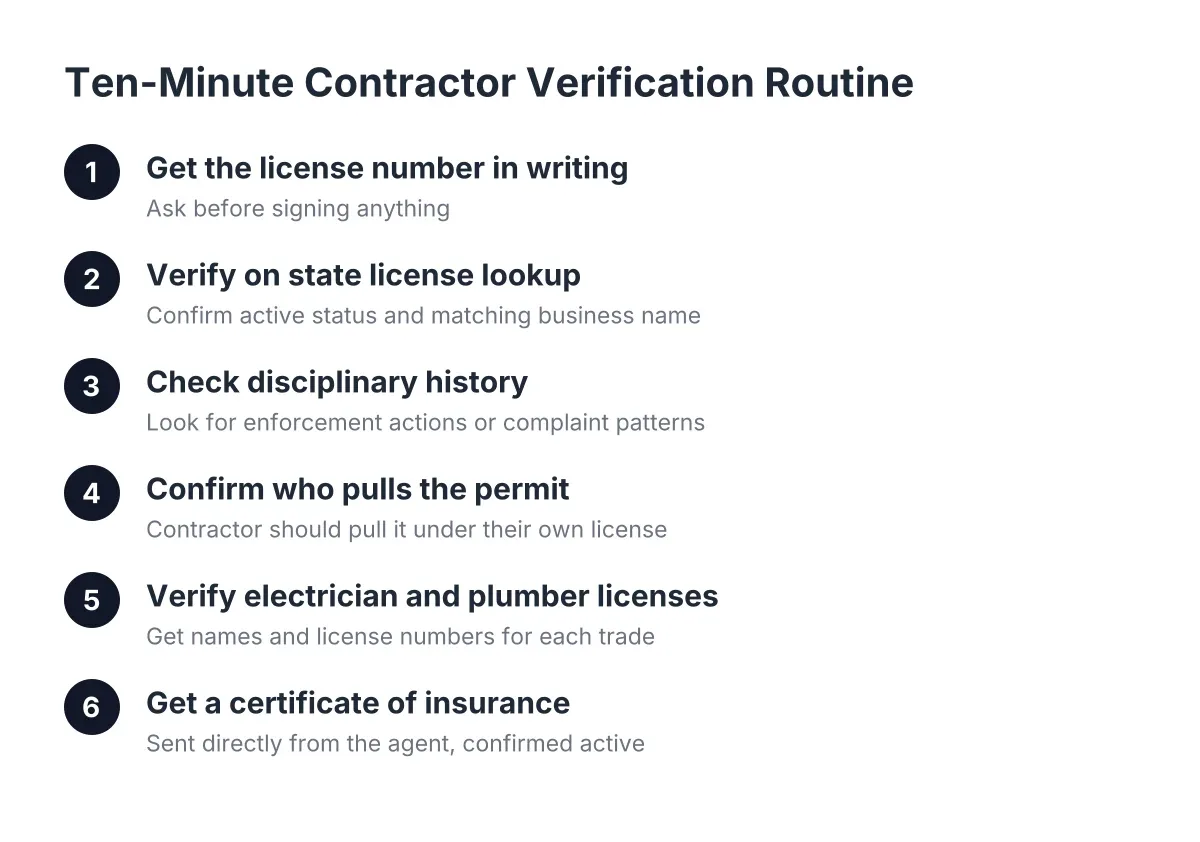
The Ten-Minute Verification Routine, Start to Finish
Before signing with any Minneapolis basement contractor, run this sequence. It takes about ten minutes plus a day of waiting, and it filters out most of the crews that cause horror stories.
- Get the exact legal business name and Minnesota license number in writing.
- Confirm the license is active on the state lookup, and check for enforcement history.
- Request a certificate of insurance sent directly from the contractor's agent, then call the agent to confirm both general liability and workers' compensation are in force.
- Ask who pulls the building, electrical, and plumbing permits, and confirm it is the contractor, not you.
- Get the names and license status of the electrician and plumber who will work on your job.
- Match the names: license, insurance certificate, and contract should all show the same entity.
- Confirm the payment schedule ties to passed inspections, not dates.
If any step stalls, if the license number "isn't handy," or the insurance certificate keeps not arriving, that hesitation is your answer. Straightforward contractors hand this paperwork over routinely because they get asked for it every week.
Finished basements are one of the few projects that add living space, resale value, and daily use all at once. The homeowners who end up happy are not the ones who found the cheapest bid; they are the ones who verified contractor license insurance before a single wall went up, tied payments to inspections, and hired someone local enough to answer the phone in year three. Do the ten minutes of homework. It is the cheapest insurance the whole project will ever have.
If you need basement finishing, Minneapolis Basement Finishing Pros can help.
Prefer to talk it through? Call (651) 758-8806 — a quick call is usually the fastest way to get a straight answer for your situation.