Basement Finishing Contractors Near Me: Why Local Minneapolis Expertise Matters
If your basement smells musty every spring, you have probably typed "basement finishing contractors near me" into a search bar and gotten a wall of directories, franchise sites, and ads. None of them answer the question you actually have: can my basement be finished at all, or will the mold just come back behind new drywall? That question has a real answer, but it depends on your specific basement, your moisture history, and local rules. A contractor in another state cannot tell you. Someone who knows Minneapolis basements can. This guide walks you through how to work with local basement finishing contractors who know your climate and code.
This guide walks through the steps a careful homeowner should take before hiring anyone. Follow them in order, and you will know whether your basement is a good candidate, what the work includes, and how to spot a straight answer when you hear one.
Step 1: Figure Out What Your Basement Is Telling You
Before you call anyone, spend an hour reading your own basement. Most of the evidence is sitting in plain sight, and knowing what you have changes every conversation that follows.
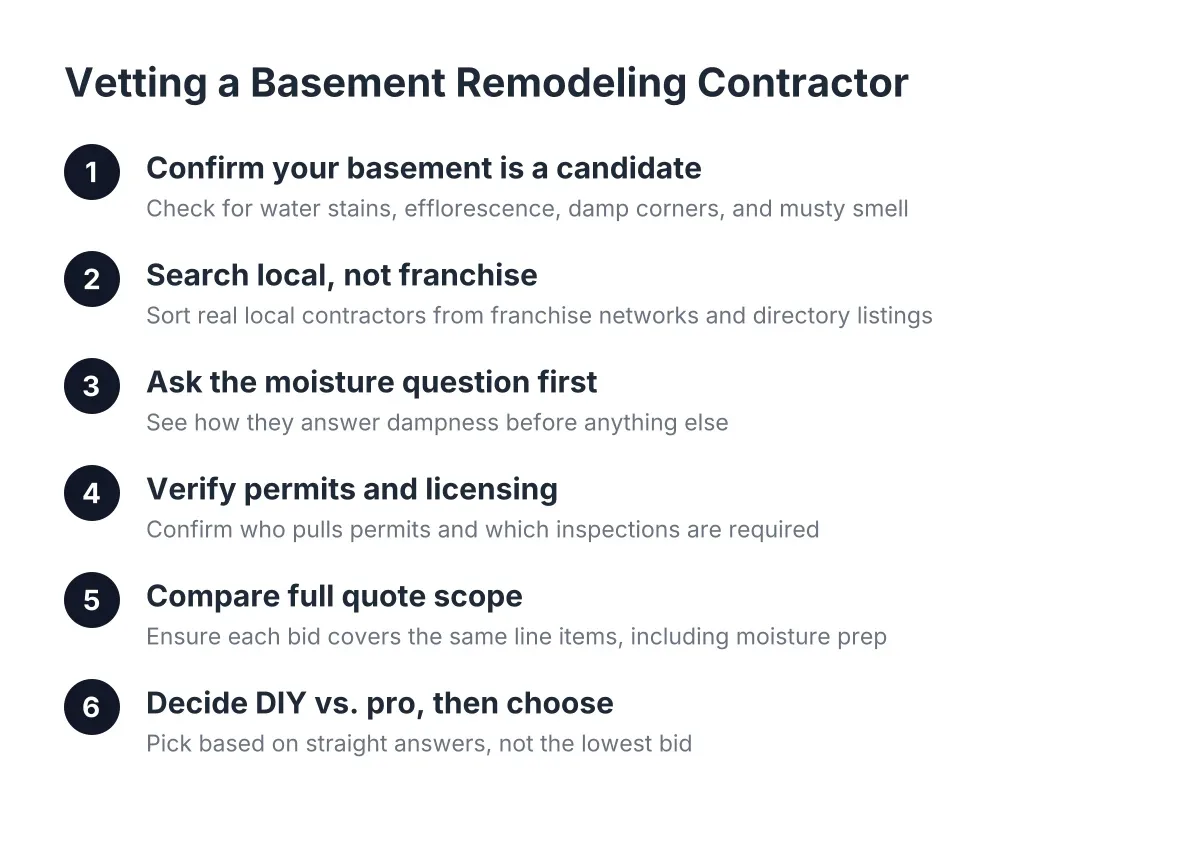
Walk the perimeter after a hard rain and look for these signs:
- Water stains or a tide line along the bottom of the foundation wall
- White, chalky residue on the concrete (efflorescence, which means moisture is moving through the wall)
- A musty smell that gets stronger in spring or after heavy rain
- Damp or dark spots under old carpet or stored boxes
- Hairline cracks that show staining around them
Here is the honest part. A basement with some of these signs can often still be finished, but only after the moisture source is handled. A basement that takes standing water every spring is not ready for framing and drywall, no matter what a salesperson says. Suppose a homeowner pulls up thirty-year-old carpet and finds black spotting on the pad near one corner. In that scenario, the right move is not to rip everything out in a panic or to cover it faster. It is to find out why that corner gets wet, which is usually grading, gutters, or a downspout dumping water against the foundation.
Step 2: Fix Moisture First, Not as an Afterthought
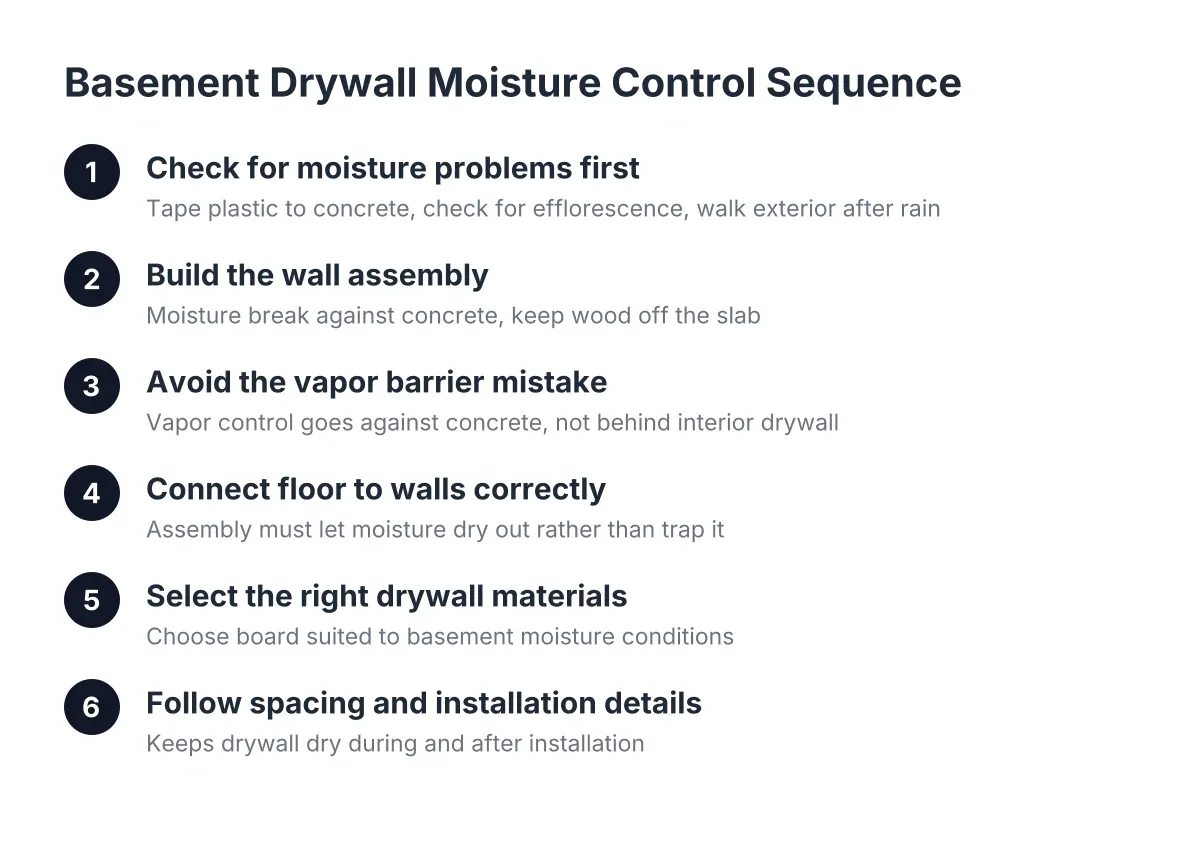
Moisture control is the single step first-time finishers skip most often, and it is the one that decides whether your finished basement still smells fine in year five. In Minneapolis, freeze-thaw cycles, spring snowmelt, and clay-heavy soil all push water toward foundations. A finishing plan that ignores this is a plan to do the job twice.
The good news is that many moisture problems have cheap fixes. Extending downspouts, regrading soil away from the house, and sealing minor cracks solve a surprising share of damp basements. Interior drainage and sump systems have their place, but they are not the default answer for every damp wall. Be skeptical of anyone who quotes a full perimeter drain system before they have looked at your gutters.
This also answers a question wet-basement homeowners ask constantly: do I need a separate waterproofing company before a finishing crew will touch the job? Sometimes yes, often no. Experienced local basement finishing contractors evaluate moisture as part of the planning visit, tell you what needs correcting, and tell you plainly if a dedicated waterproofing specialist should handle a structural or drainage issue first. If a contractor will not talk about moisture before talking about layout, keep looking.
One more detail that matters under your feet. According to W. R. Meadows, a vapor barrier placed under a concrete slab is meant to block moisture transmission from the ground into the concrete above. Many older Minneapolis homes were built without one, which is why flooring choice and subfloor systems matter so much here. A local contractor plans for that; a generic checklist does not.
Step 3: What a Full Basement Finishing Scope Includes
Once moisture is sorted, you need a clear picture of what the work actually covers, so you can compare quotes fairly. A complete basement finishing project in Minneapolis typically includes:
- Layout and design, including where walls, doors, and mechanical access go
- Permits and scheduled city inspections
- Framing and insulation that meets Minnesota's cold-climate code
- Electrical rough-in, then drywall, paint, and trim
- Basement flooring suited to a below-grade slab
- Optional phases such as a basement bathroom or wet bar
A few things usually cost extra or come later: egress windows where a bedroom is planned, bathroom plumbing if there is no existing rough-in, and upgraded ceilings or built-ins. Trim work also surprises first-timers. A finished basement often carries more baseboard, casing, and paneling than any other room in the house, and that labor adds up.
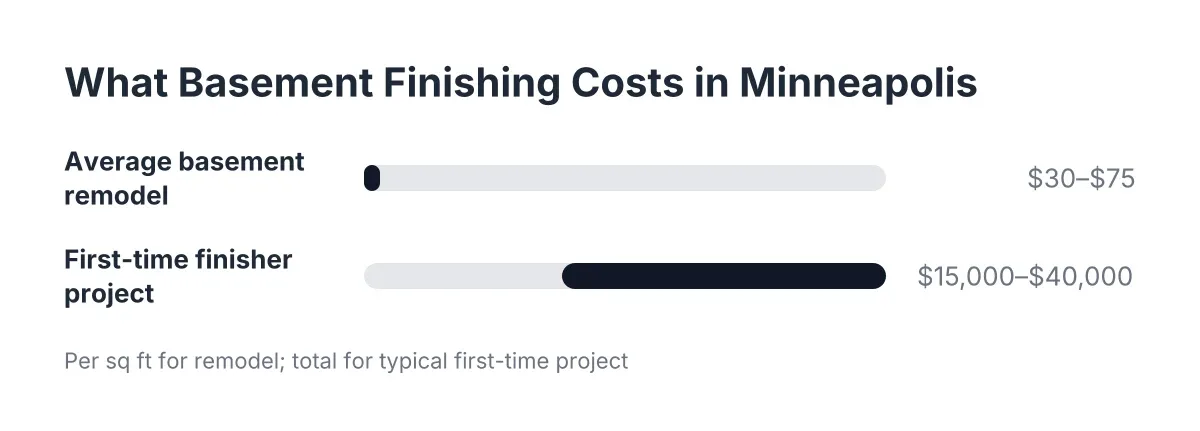
On timing and budget, expect a straightforward finish to run several weeks to a few months depending on scope and inspection scheduling. For cost, an average basement remodel runs between $30 and $75 per square foot according to Angi, with high-end projects exceeding $120. Many first-time finishers in the $15,000 to $40,000 range phase the work, framing and flooring first, bathroom later. A good contractor will help you phase honestly instead of pushing everything at once.
Step 4: Decide What You Can DIY and When to Call a Pro
Basements are a forgiving place to learn, since cosmetic imperfections hide better than they would in a kitchen. However, the line between homeowner work and licensed work is firm, and crossing it creates inspection and insurance problems.
What a handy homeowner can reasonably take on: demolition, painting, installing some flooring types, and hanging trim. What belongs with licensed trades: electrical and HVAC work, which require licensing and skill regardless of how good your framing is, plus any plumbing for a basement bathroom. Even committed DIYers typically hire out those trades.
There are also warning signs that mean call a professional now, not after you finish researching: active water entry, a sewer smell, foundation cracks wider than a coin, or visible mold covering more than a small patch. Those are not finish-work problems. They need diagnosis before anyone opens a wall.
Step 5: Understand Minneapolis Permits and Inspections
Finishing a basement in Minneapolis requires permits, and that is a feature, not a hassle. Inspections are the independent check that the wiring, insulation, and framing behind your new drywall were done right. As of 2026, plan on at least two separate inspections early in the process: an electrical rough-in inspection, followed later by an insulation inspection before drywall goes up.
Unpermitted basement work creates real problems at resale, when a buyer's inspector or appraiser asks for records the city does not have. A legitimate local contractor pulls the permits, schedules the inspections, and builds them into the timeline. If anyone suggests skipping permits to save time or money, that tells you everything about how the hidden work will be done.
Step 6: How to Evaluate Local Basement Finishing Contractors Near Minneapolis
A local operation and a national franchise can both put up drywall. The difference shows in the questions they ask before quoting. A contractor who works Minneapolis basements every week should talk about your slab's moisture, Minnesota insulation code, winter construction scheduling, and how your 1950s rambler's layout compares to others on your block. A national network routing your call to whoever is available cannot do that.
For example, layout is where local experience quietly saves money. A common mistake leaves the area at the bottom of the stairs as dead storage and finishes only one side of the basement, wasting the most usable space near the entry. Someone who has designed dozens of similar footprints catches that in the first walkthrough.
Local knowledge also tempers the sales pitch on value. Resale returns on basement remodels vary widely by market, from as little as 23% to as much as 86% according to Zonda / Journal of Light Construction, so anyone quoting a guaranteed payback is guessing. The stronger case is livability: homeowners gave basement finishing a joy score of 9.5 out of 10 in the National Association of Realtors Remodeling Impact Report, and the same report found 64% of costs recovered at sale, among the highest of the projects studied.
Step 7: Ask Three Questions Before You Sign Anything
When you narrow your search for basement finishing contractors near you down to two or three bids, ask each one the same three questions and compare the answers:
- What moisture issues do you see in this basement, and what has to happen before finishing starts?
- Who pulls the permits, and which inspections are built into your schedule?
- What is included in this price, and what is a likely extra?
A fair quote is itemized, tied to a written scope, and honest about allowances for things like flooring selections. Vague lump sums and pressure to sign today are the two clearest signs to walk away. A free estimate should cost you nothing but an hour, and it should leave you knowing more about your own basement than you did before.
Every basement is different, and a damp one deserves an in-person look rather than a diagnosis over the internet; some moisture or structural problems genuinely need a specialist before any finishing conversation makes sense. If you are in Minneapolis or the surrounding area and want a straight answer on whether your basement is ready, reach out for a free estimate. You will get a plain assessment of moisture, layout, and cost before any work begins, which is exactly where a good project starts.
If you need basement finishing, Minneapolis Basement Finishing Pros can help.
Prefer to talk it through? Call (651) 758-8806 — a quick call is usually the fastest way to get a straight answer for your situation.