9 Questions to Ask Basement Contractors Before You Request a Quote
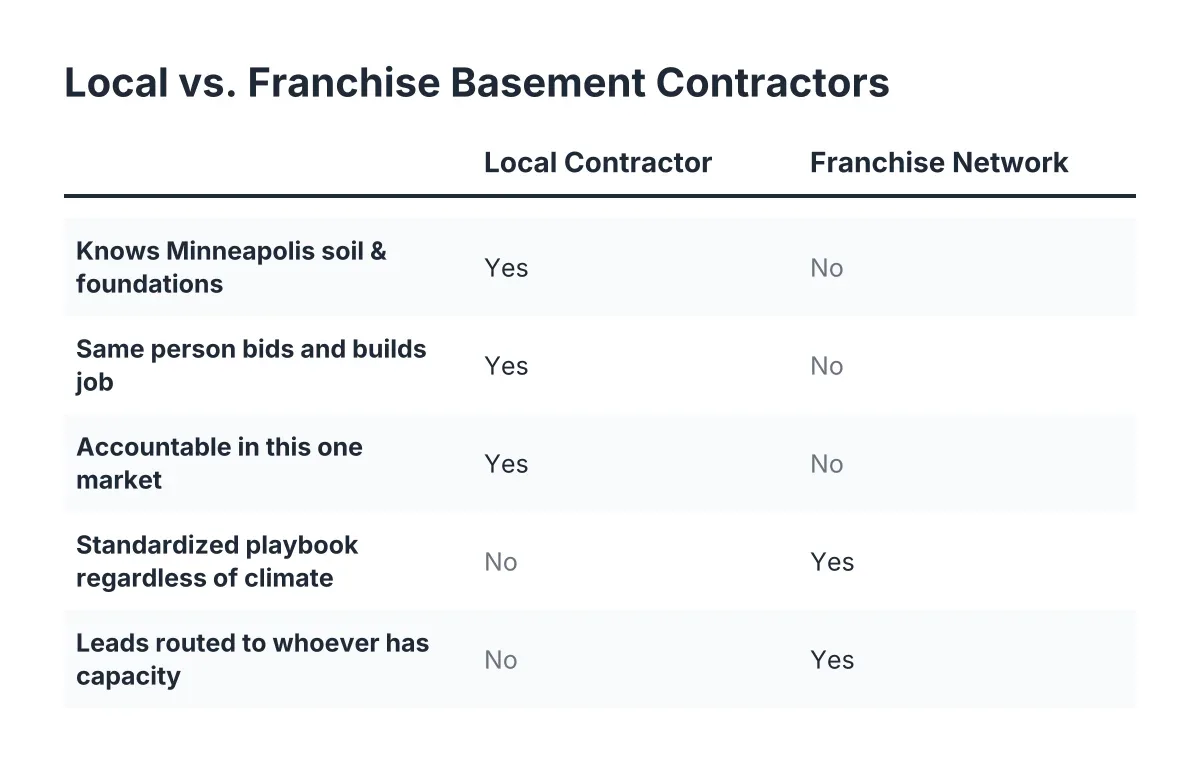
If you are finishing a basement to boost resale value or rental income, the estimate is not the first step. The right questions to ask basement contractors come before any quote request, because the answers tell you whether a bid is grounded in your actual basement or copied from a national playbook. Franchise basement-finishing networks route leads to whoever is on call and standardize the job around their product system. That model can work fine in some markets, but Minneapolis basements have their own moisture conditions, foundation quirks, and permit process. A contractor who cannot speak to those specifics will still hand you a number. It just will not be a number you can trust when you are running ROI math.
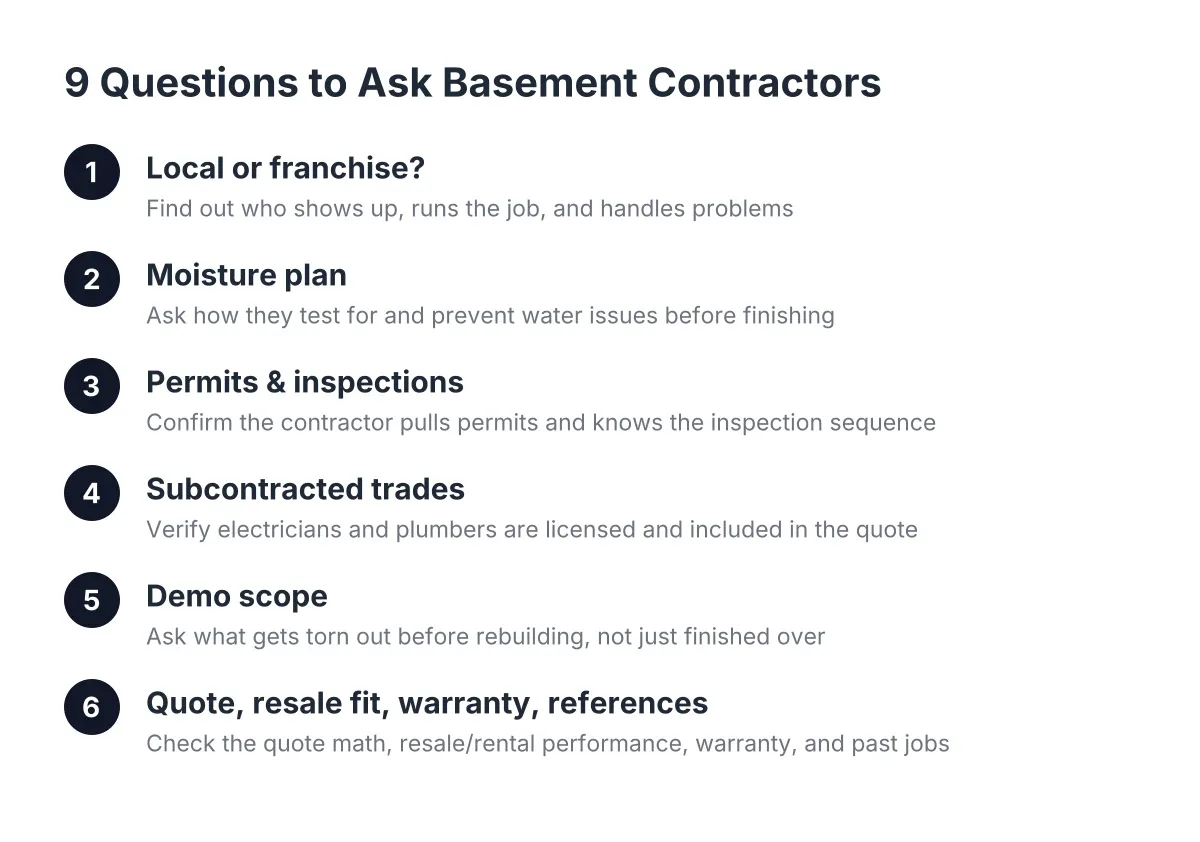
Here are nine questions worth asking before you sign anything, along with what a straight answer sounds like and what should make you keep looking.
1. Are You a Local Operation or Part of a Franchise Network?
This is the first of the basement contractor questions to ask because it shapes everything downstream. A national franchise typically sells a standardized wall panel or finishing system, prices from a corporate book, and dispatches whichever crew is available. A local basement remodeling contractor builds each job around the specific house.
Neither model is dishonest, but they serve different buyers. If you are an investor trying to hit a resale number in a Minneapolis starter-home neighborhood, a standardized system can push you into finishes and pricing that do not match the block. A local operator can tell you what a 1950s Minneapolis basement with a low ceiling and an old floor drain actually needs, and what it does not.
Ask directly: who will show up for the estimate, who will run the job, and who do I call when something goes sideways? If the answers involve a call center, factor that into your comparison.
2. How Do You Handle Moisture Before Finishing Anything?
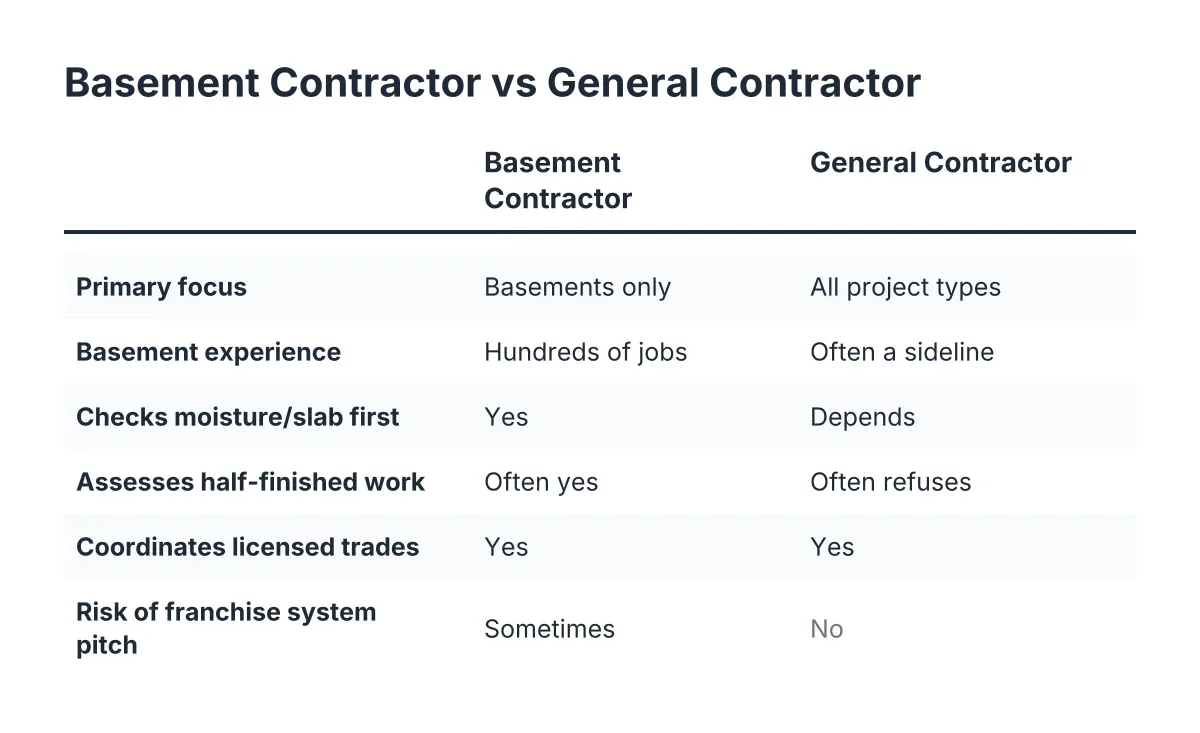
Moisture is the question that separates basement specialists from crews that just do drywall below grade. Any contractor bidding your basement should walk the space looking for water staining, efflorescence on the block, and grading or gutter problems outside before they talk about layout or flooring. Insulating and finishing over an unresolved moisture problem is the fastest way to turn a value-add project into a tear-out.
For context, a vapor barrier under a concrete slab exists to block moisture moving from the ground into the concrete above, according to W. R. Meadows. Older Minneapolis homes often have no such barrier, which is exactly why a contractor needs a moisture plan specific to your slab and walls, not a one-size answer.
A good answer names specifics: where they expect moisture to show up, what testing or observation they want to do, and what waterproofing or drainage work would come before framing. A bad answer is "our system handles that." Press on what "handles" means.
3. Who Pulls the Permits, and What Inspections Should I Expect?
The contractor should pull the permits, full stop. In Minneapolis, a basement finish that adds bedrooms, a basement bathroom, or new electrical circuits will go through city permitting and inspections. A contractor who suggests skipping permits to save money is handing you a problem that surfaces at appraisal or sale, which is exactly when you, as a flipper, cannot afford it. Unpermitted finished square footage may not count toward value at all.
Ask them to walk you through the inspection sequence. Basement projects typically involve multiple inspections early in the process, such as an electrical rough-in inspection followed later by an insulation inspection. A contractor who can describe that sequence from memory has done this in your city. One who gets vague has not, or plans to work around it.
4. Which Trades Do You Sub Out, and Are They Licensed?
No basement finishing crew does everything in-house well. Electrical and HVAC work call for licensed trade contractors, and the standard practice is to bring in a licensed electrician for the wiring even when the same crew handles framing, drywall, and finish carpentry. Plumbing for a basement bathroom is the same story.
Therefore, ask which parts of the job are subcontracted and who those subs are. You want to hear that the electrician and plumber are licensed, that the general contractor coordinates their inspections, and that their work is included in the single quote you receive. Red flag: a bid where "electrical by others" appears in fine print, which means you are hiring and managing a second contractor you did not budget for.
5. What Would You Tear Out Before You Build?
This question exposes whether a contractor is bidding the job or bidding the square footage. Say a homeowner in Minneapolis buys a duplex with a half-finished basement: some framed walls with old fiberglass insulation stuffed against the concrete, a dropped ceiling, and carpet on the slab. A crew that quotes finishing "the rest" without addressing that assembly is setting up a hidden-mold surprise mid-project.
Experienced contractors often recommend tearing out framed walls with insulation sitting against concrete and starting over, because building on top of a bad assembly locks the problem in. In that hypothetical duplex scenario, the honest bid includes demo, and it will be higher than the bid that ignores it. As an investor, you want the higher honest number in your pro forma, not a change order in month two.
6. Questions to Ask Basement Contractors About the Quote Itself
Once the basics check out, the quote is where inflated bids and lowball traps hide. These questions ask basement contractors to show their math, and how they respond tells you as much as the numbers do.
- Is this a fixed price or an estimate, and what triggers a change order?
- What allowances are built in for flooring, fixtures, and the basement bathroom, and what happens if I pick cheaper materials?
- What is specifically excluded? Look for exclusions on waterproofing, egress, electrical panel upgrades, and permit fees.
- How do you structure payments? A large deposit before any work starts deserves scrutiny.
- How long is this price good for, and what happens if material costs move?
That last one matters in 2026 as much as any year. When material prices spike, a fair contractor will say so and may even suggest waiting rather than locking you into a padded number. For a rough sanity check on any bid, an average basement remodel runs $30 to $75 per square foot according to Angi, with high-end work above $120. A Minneapolis bid far outside that band, in either direction, needs an explanation.
7. How Will This Layout Perform at Resale or as a Rental?
A contractor working with investors should have opinions about layout and value, not just construction. The features that move appraisals are conforming bedrooms with proper egress, a basement bathroom, and open living space that reads as real square footage. A wet bar or a custom theater wall rarely returns its cost in a modest neighborhood.
The national numbers back up a disciplined approach. The National Association of Realtors found that 64% of basement finishing costs are recovered at sale, one of the highest recovery rates among 20 common projects. However, returns swing widely by market; Zonda and the Journal of Light Construction report resale recoup ranging from 23% to 86% depending on the area. Translation for a flipper: the layout decisions matter more than the finish level. Ask the contractor which choices in their proposal add appraised value and which are lifestyle upgrades you could cut. A pro who helps you cut scope is a pro worth hiring.
One honest caveat: basements are among the harder projects to pencil out, and a finish only clearly pays off when the plan matches what buyers or renters in that specific neighborhood will pay for. If you are unsure, run the numbers with a local agent or appraiser before committing to the full scope.
8. What Does Your Warranty Actually Cover?
Basement finishing warranty language varies more than most homeowners expect. Franchise systems often advertise long product warranties that cover their proprietary panels but not the labor, the flooring, or the moisture conditions underneath. A local contractor's workmanship warranty may be shorter on paper but broader in practice.
For example, ask what happens if the basement flooring cups or the drywall shows moisture staining eighteen months in. Who investigates, who pays, and does the warranty survive if you sell the house? For a flipper, a transferable warranty is a genuine selling point at listing time; a warranty void on transfer is worth almost nothing to you. Get the answer in writing before you compare bids, because two identical prices with different warranty terms are not identical prices.
9. Can You Show Me a Comparable Local Job?
Finish the vetting by asking for a recent basement project similar to yours in age of home, scope, and budget. Photos are fine; an address or a reference from a past client is better. You are checking two things: that the contractor has done this exact kind of work in Minneapolis-area homes, and that the finished result matches the price band you are targeting for resale.
When you search "basement remodeling contractors near me," you will get a mix of franchise landing pages, thin directory listings, and actual local operators. The comparable-job question filters that list fast. A franchise call center can send stock photos from another state. A crew that finished a basement two miles from yours last winter can tell you what the inspector flagged and how the moisture behaved through a freeze-thaw cycle.
What a Fair Basement Finishing Quote Looks Like
After hiring a basement contractor who answered these questions well, the quote itself should be boring in the best way. It lists scope room by room, names the flooring and fixture allowances, includes permits and inspections, states the payment schedule, and spells out exclusions instead of hiding them. Nothing in it should surprise you, because the conversation already covered the hard parts.
Compare at least two or three bids this way, and weight the answers as heavily as the totals. The cheapest bid from a contractor who dodged the moisture question is the most expensive bid on the table; you just will not find out until after drywall. For an ROI-focused project, the contractor who tells you what to cut, what to fix first, and what the city will inspect is the one protecting your margin. That is worth more than any sales pitch, and it is exactly what these questions are built to surface before you ever ask for a number.
If you need basement finishing, Minneapolis Basement Finishing Pros can help.
Prefer to talk it through? Call (651) 758-8806 — a quick call is usually the fastest way to get a straight answer for your situation.