How to Vet Basement Remodel Contractors in Minneapolis: Local Signals That Matter
You have decided to finish the basement. Now the job is picking the right crew, and that choice matters more than the flooring, the paint, or the layout. In Minneapolis, basement remodel contractors fall into a few camps: local operators who know these houses, franchise networks that route your lead to whoever is on call, and fly-by-night crews who disappear when the drywall cracks. This guide shows you how to tell them apart before you sign anything, what questions expose a weak bid, and what a fair quote looks like when resale value is the whole point of the project.
If you are finishing a basement to sell or rent, the stakes are specific. A bad contractor does not just cost you money during the build; they cost you money at closing when the buyer's inspector flags unpermitted work or moisture damage behind fresh drywall. Everything below is aimed at protecting that margin.
Why Local Knowledge Beats a Franchise Playbook
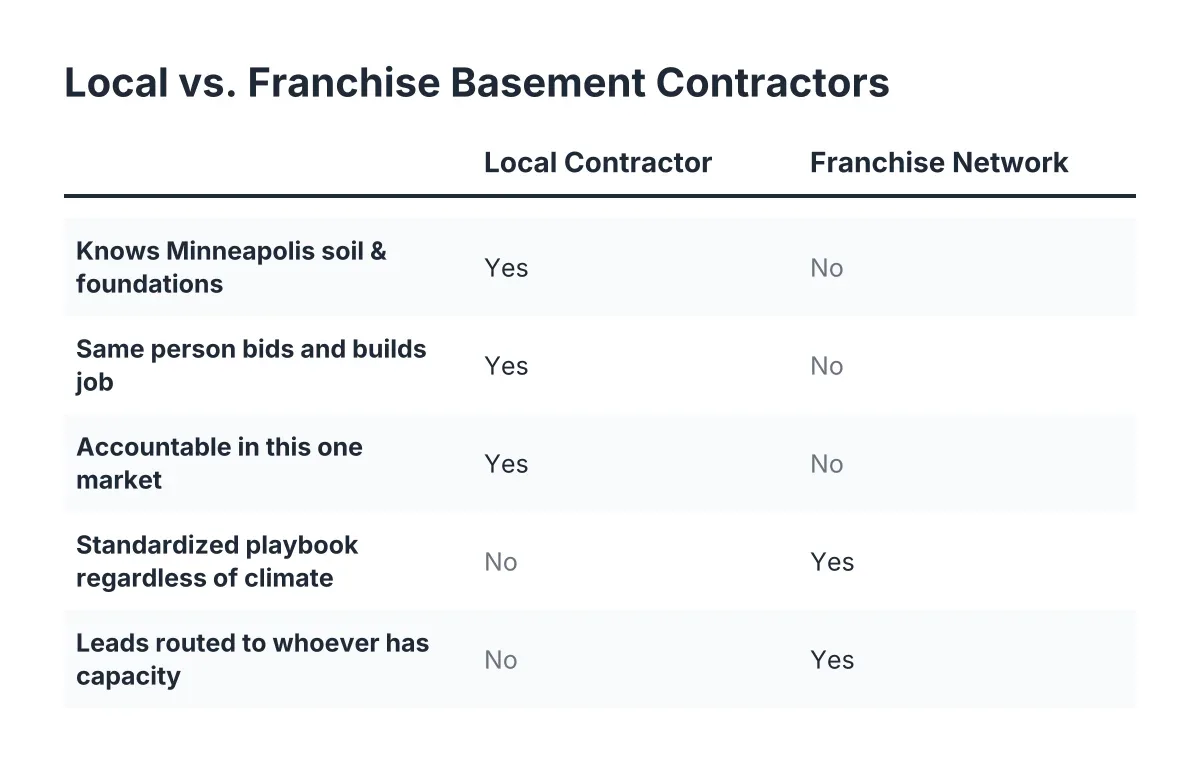
National basement-finishing franchises sell a standardized system. The wall panels, the flooring product, the process, all of it comes from a corporate playbook designed to work the same way in Phoenix and Philadelphia. That standardization is the pitch. It is also the problem.
Minneapolis basements are not generic. Most of the housing stock here is old enough that you will find rubble or block foundations, low ceiling heights, clay soil that holds water against the walls, and freeze-thaw cycles that move concrete in ways a Sun Belt playbook never accounts for. A contractor who has opened up dozens of Minneapolis basements knows what a chalky white stain on the block means, where the water table sits after spring melt, and why a vapor strategy that works in a dry climate fails here.
Franchise networks also route leads. You fill out a form, and the job goes to whichever affiliated crew has capacity. The person who impressed you on the phone may never set foot in your basement. With a local operation, the person who bids the job is accountable for the job. When something goes sideways in week three, you know exactly who answers the phone.
None of this means every local contractor is good or every franchise crew is bad. It means the franchise structure removes the two things you need most on a basement project: someone who has seen your specific problem before, and someone whose reputation in this one market depends on your job going well.
What Separates Good Basement Remodel Contractors From the Rest
The difference shows up before any contract gets signed. Watch how a contractor behaves during the estimate visit, because that visit predicts how they will behave during the build.
A serious contractor spends real time in your basement before quoting. They check the walls and floor for moisture signs, look at where the mechanicals sit, measure ceiling height, and ask what you plan to do with the space. If you tell them the goal is resale, a good one will talk you out of over-improving, not upsell you. Suppose you own a starter home and the contractor pushes a custom wet bar and heated floors; that is a contractor selling scope, not solving your problem.
Here are the signals that consistently separate quality basement remodel contractors from the crews you want to avoid:
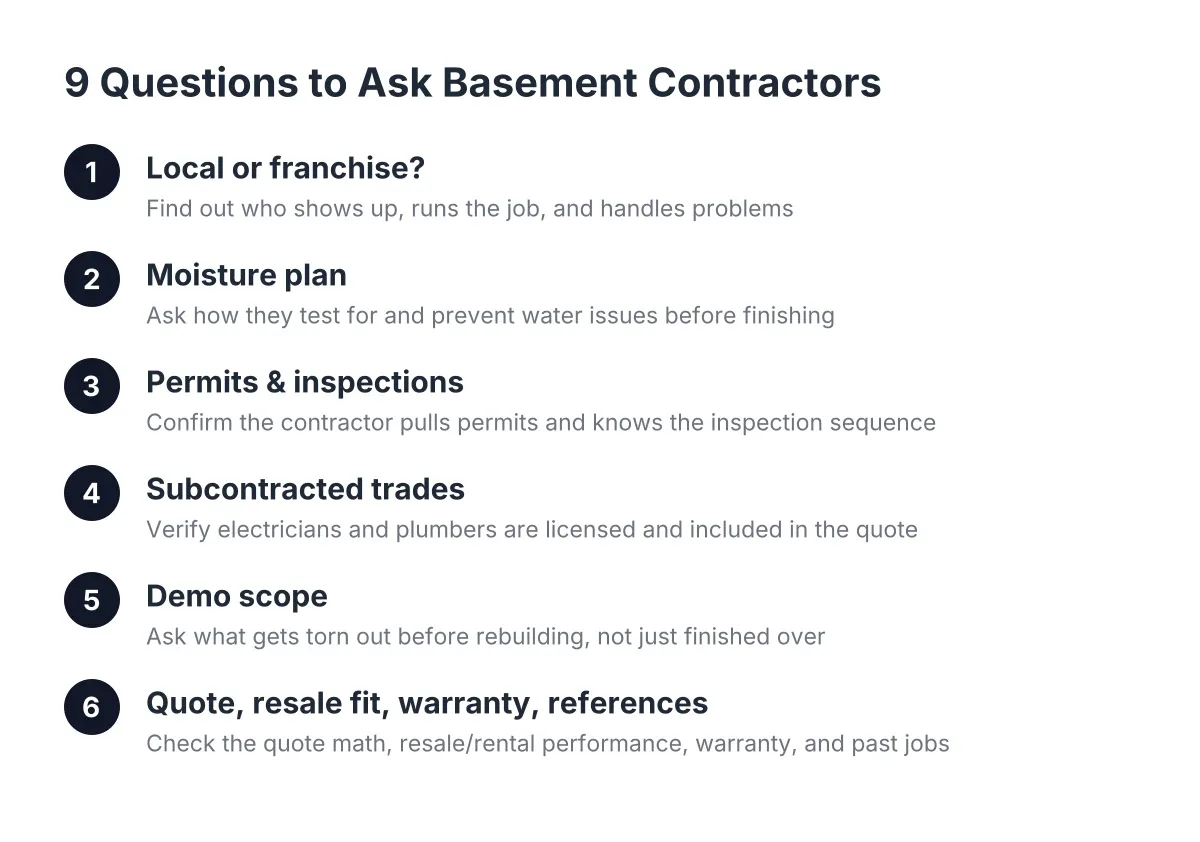
- They bring up moisture before you do. Any Minneapolis contractor who quotes a basement finish without addressing water is quoting a future failure. Finishing over a moisture problem is the most expensive mistake in this trade.
- They talk about permits without being asked. Finished square footage only counts at appraisal if the work is permitted and inspected. A contractor who suggests skipping permits is transferring risk directly to you.
- They explain the inspection sequence. Basement projects typically involve separate inspections, including an electrical rough-in inspection and a later insulation inspection. A contractor who can walk you through that order has done this before.
- They put licensed trades on licensed work. Electrical and HVAC work in a basement should go to licensed electricians and HVAC contractors, even when the same crew handles framing, drywall, and trim. Ask directly who pulls the electrical permit.
- Their bid is itemized. A one-line quote for the whole job tells you nothing about what is included and gives you no leverage when scope changes mid-project.
- They are licensed and insured, and they prove it. Ask for the license number and a certificate of insurance. Then verify both yourself instead of taking a business card's word for it.
Notice what is not on that list: the lowest price. On basement work, the lowest bid usually means the thinnest moisture prep, the fewest permits, or a crew that plans to make it up on change orders.
Questions That Expose a Weak Bid
Ask every contractor the same set of questions and compare the answers side by side. Vague answers on any of these are a warning, not a personality quirk.
- How will you handle moisture in this specific basement? You want a concrete answer tied to what they observed in your space, not a generic mention of waterproofing. For context, a vapor barrier under a concrete slab exists to block moisture moving from the ground into the concrete, according to W. R. Meadows. A contractor should be able to explain what your slab and walls are doing and how the finish plan accounts for it.
- Who pulls the permits, you or me? The right answer is the contractor. When a contractor asks the homeowner to pull permits, they are often dodging accountability with the city.
- Which parts of the job do your own crew do, and which do you sub out? Subcontracting is normal. Not knowing who the subs are is not.
- What does your warranty cover, and for how long? Get the basement finishing warranty in writing. Ask specifically whether it covers moisture-related failures, since that is where basement finishes actually fail.
- What is your payment schedule? A reasonable schedule ties payments to completed milestones. A demand for half the money upfront is a red flag in any trade, and doubly so in basement work.
- Can I see a comparable finished basement or talk to a past client? Local contractors have local jobs to show. Franchise-routed crews often do not.
However you weight the answers, the pattern matters more than any single response. A contractor who answers five questions well and dodges the moisture question is still the wrong contractor for a Minneapolis basement.
Red Flags That Should End the Conversation
Some problems are worth negotiating through. These are not.
First, no license or insurance documentation. If the paperwork is "at the office" twice, walk. Second, pressure to skip permits to save money. Unpermitted basement finishes get discovered at sale, and the fix at that point costs far more than the permit ever would. Third, a bid dramatically below the others. On a project where three bids cluster within 15 percent of each other, a fourth bid at half the price is not a bargain; it is missing scope.
In addition, be cautious with any contractor who cannot explain the electrical plan in plain terms. Basement wiring has real code requirements. For example, running non-metallic sheathed cable as exposed wiring is not best practice, and running it inside EMT conduit violates code in damp or wet locations, according to the National Electrical Code. You do not need to memorize the code book. You do need a contractor who clearly has.
Finally, watch for the contractor who quotes without measuring. A basement finish priced from the driveway is a number invented to win the job, and it will grow once the walls are open.
What a Fair Basement Remodel Quote Looks Like
A fair quote for a basement remodel is itemized, tied to a written scope, and consistent with local per-square-foot norms. According to Angi, an average basement remodel runs between $30 and $75 per square foot, with high-end projects exceeding $120. Where your quote lands in that range depends on the bathroom, the ceiling treatment, the flooring, and how much moisture prep the space needs.
For the flipper running numbers, that range is your first sanity check. Say you are pricing out a 900 square foot finish on a rental duplex. At the mid-range, you are looking at roughly $45,000 to $65,000 as an illustrative estimate, and any bid far outside that band needs a line-by-line explanation. A finish basement cost that seems too good is usually missing the items that protect resale value: permits, licensed electrical, and moisture prep.
Compare bids by scope, not just the bottom line. Two quotes $8,000 apart may reflect different flooring products, different bathroom fixtures, or one contractor including egress work the other ignored. In 2026, with material prices still moving, also ask how the quote handles price changes; a fixed-price contract and a cost-plus contract shift that risk in opposite directions. When materials are spiking sharply, delaying the project a season can beat starting mid-spike.
One honest trade-off worth naming: basement finishing rarely returns more than it costs at sale. The National Association of Realtors Remodeling Impact Report found homeowners recover about 64 percent of basement finishing costs at sale, which was still among the highest of the 20 projects studied. Returns vary widely by market, from as little as 23 percent in some areas to 80 to 86 percent in others, according to Zonda. If your resale math only works at 100 percent cost recovery, rework the math before hiring anyone.
That said, the recovery number is not the whole picture for every owner. Homeowners rated basement finishing 9.5 out of 10 on the joy score in the NAR Remodeling Impact Report. For a couple in their sixties converting the basement into a guest suite for visiting grandkids or a future main-floor-adjacent living setup for an aging parent, the value is in using the space for the next fifteen years, not the next listing.
Basement Remodel Contractors vs. General Contractors
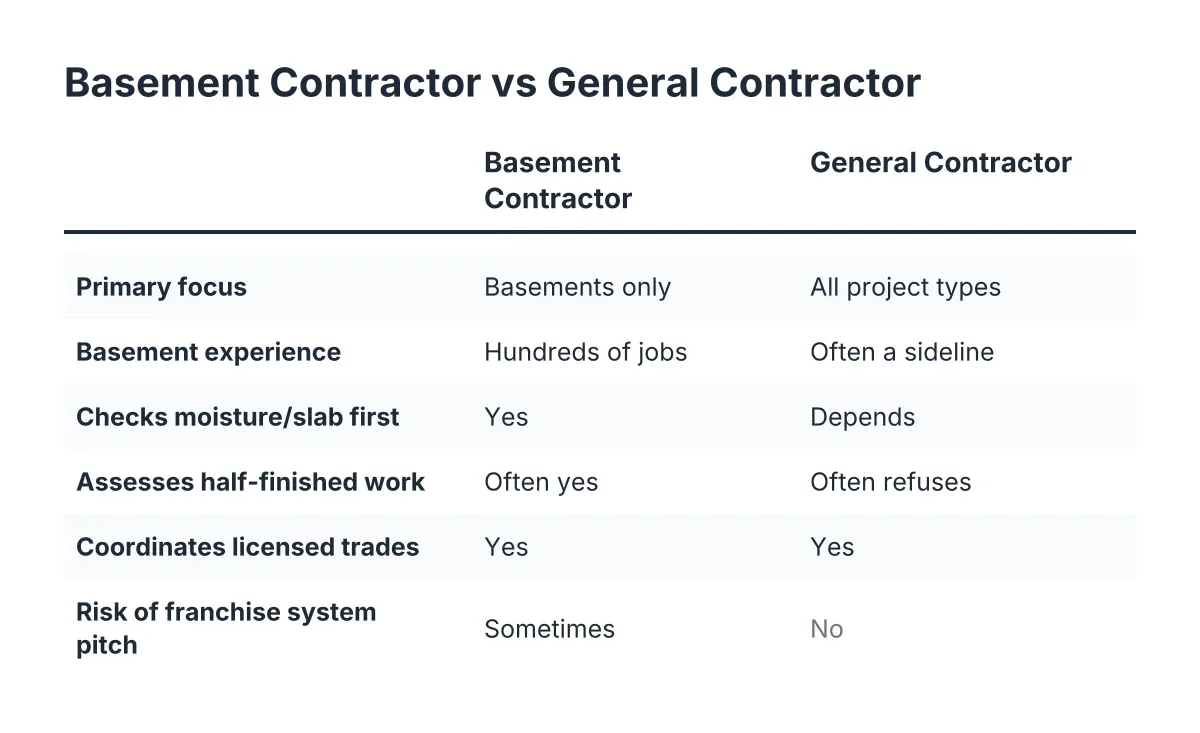
A general contractor can legally build your basement, and a basement finishing specialist is often a general contractor by license. The difference is repetition. A GC who mostly builds decks and kitchens treats your basement as one more room. A contractor who finishes basements week after week has already solved the problems your basement is about to present.
Those problems are specific to below-grade work. Moisture management comes first, always. Then layout around fixed mechanicals, since the furnace, water heater, and main drain stack are not moving without serious cost. Then ceiling height, ductwork soffits, and where a bathroom can drain without breaking up more slab than necessary. A specialist plans around these constraints from the first sketch. A generalist discovers them during demo.
For example, consider drain placement on a basement bathroom. Suppose the existing rough-in sits on the far side of the basement from where a generalist drew the bathroom. A specialist designs the layout around the rough-in and saves you thousands in slab work. That single layout decision can swing the bathroom cost more than any fixture choice you make.
If your project extends beyond the basement, kitchen above, addition on the back, a GC coordinating everything makes sense. If the project is the basement, hire the crew that does basements. Either way, some situations call for outside professionals regardless of who you hire: standing water, foundation cracks that are actively moving, or radon concerns all warrant an independent specialist's evaluation before finishing work starts.
Getting Solid Bids Without Wasting a Month
Once you know what to look for, the process of hiring a basement contractor comes down to running a clean comparison. Here is a sequence that works.
Start by writing a one-page scope before you call anyone. List the square footage, whether you want a basement bathroom, the number of rooms, and your flooring preference. When every contractor bids the same scope, the bids are actually comparable. When each contractor invents their own scope, you are comparing three different projects.
Next, get three bids, and make one of them local. Searching "basement remodel near me" or "basement finishing contractors near me" will surface a mix of franchise lead-capture pages and actual local operations. You can usually tell them apart by the estimate process: a local contractor sends the person who will run your job; a lead network sends whoever is on rotation. Free estimates are standard in this market, so a contractor who charges for a basic quote is an outlier.
Then verify before you compare prices. Check the license with the state, confirm insurance, and look for permit history on their past jobs if your city publishes it. Ten minutes of verification here saves you from the entire bottom tier of the market.
Finally, compare the bids line by line against your scope sheet. Flag anything one bid includes that the others skipped, and ask about it directly. The contractor who explains the gap clearly, without getting defensive, is usually the one who will communicate that same way when your job hits a surprise behind the wall.
The Bottom Line for Minneapolis Homeowners
Choosing between basement remodel contractors is less about finding a unicorn and more about filtering out the two failure modes: standardized franchise systems that do not know Minneapolis basements, and cheap crews that cut permits and moisture prep to win on price. The contractor you want sits in the middle, local, licensed and insured, specific about moisture and inspections, and willing to put an itemized scope in writing.
For the investor, that contractor protects your margin at closing. For the long-tenure homeowner building a guest suite or planning for a parent to move in, that contractor builds a space that stays dry and comfortable for decades instead of failing in year three. Same vetting process, same signals, and the same rule underneath it all: in a Minneapolis basement, local knowledge is not a nice-to-have. It is the job.
If you need basement finishing, Minneapolis Basement Finishing Pros can help.
Prefer to talk it through? Call (651) 758-8806 — a quick call is usually the fastest way to get a straight answer for your situation.