How Much Does Basement Flooring Cost?
How much does basement flooring cost? The honest answer depends on three things: the material you pick, the condition of the concrete slab underneath, and whether your basement has a moisture problem that needs fixing first. Anyone who quotes you a firm number before looking at your slab is guessing, and a guess is not a budget. This guide walks through what actually moves the price up or down in a Minneapolis basement, so by the end you will know exactly what to check, what to ask, and how to get a real number instead of an internet average.
What Drives the Cost of Basement Flooring
Five factors do most of the work in a basement flooring quote. Here is each one, which way it pushes the price, and how to tell where your basement stands.
The Material You Choose
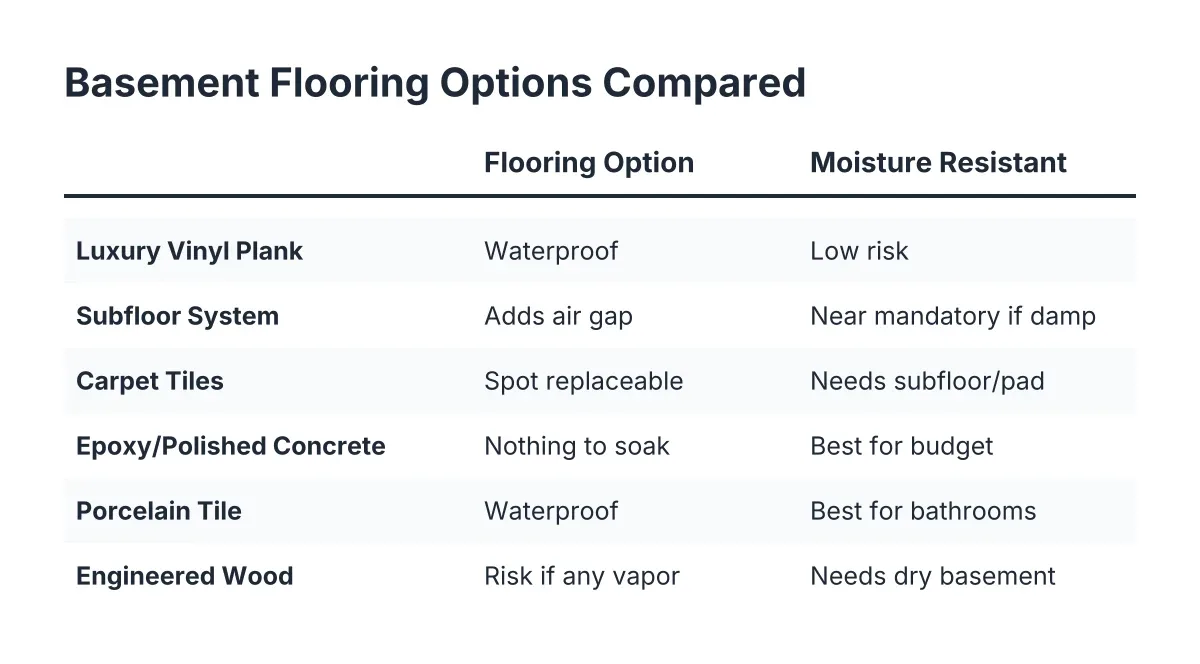
This is the biggest swing in the whole project. Luxury vinyl plank, carpet, epoxy coating, engineered wood, tile, and stained or polished concrete all sit at different price points, and the gap between the cheapest and most expensive option in a single basement can be wide. Material also drives labor: tile takes longer to set than vinyl plank clicks together, and that time shows up on your quote. To figure out where you land, decide what the space is for first. A workout room and a guest bedroom do not need the same floor, and picking the material to match the use, not the showroom, keeps the price honest.
The Condition of Your Concrete Slab
Every basement floor sits on the slab, and the slab decides how much prep work you pay for. A flat, dry, crack-free slab needs little more than cleaning. A slab with cracks, low spots, or old adhesive from a previous floor needs grinding, patching, or self-leveling compound before anything goes down. In older Minneapolis homes, slabs that have settled or heaved over decades of freeze cycles are common. You can check this yourself: lay a long straightedge or level across the floor in several spots. Gaps under it mean leveling work, and leveling work means a higher price.
Moisture and Waterproofing
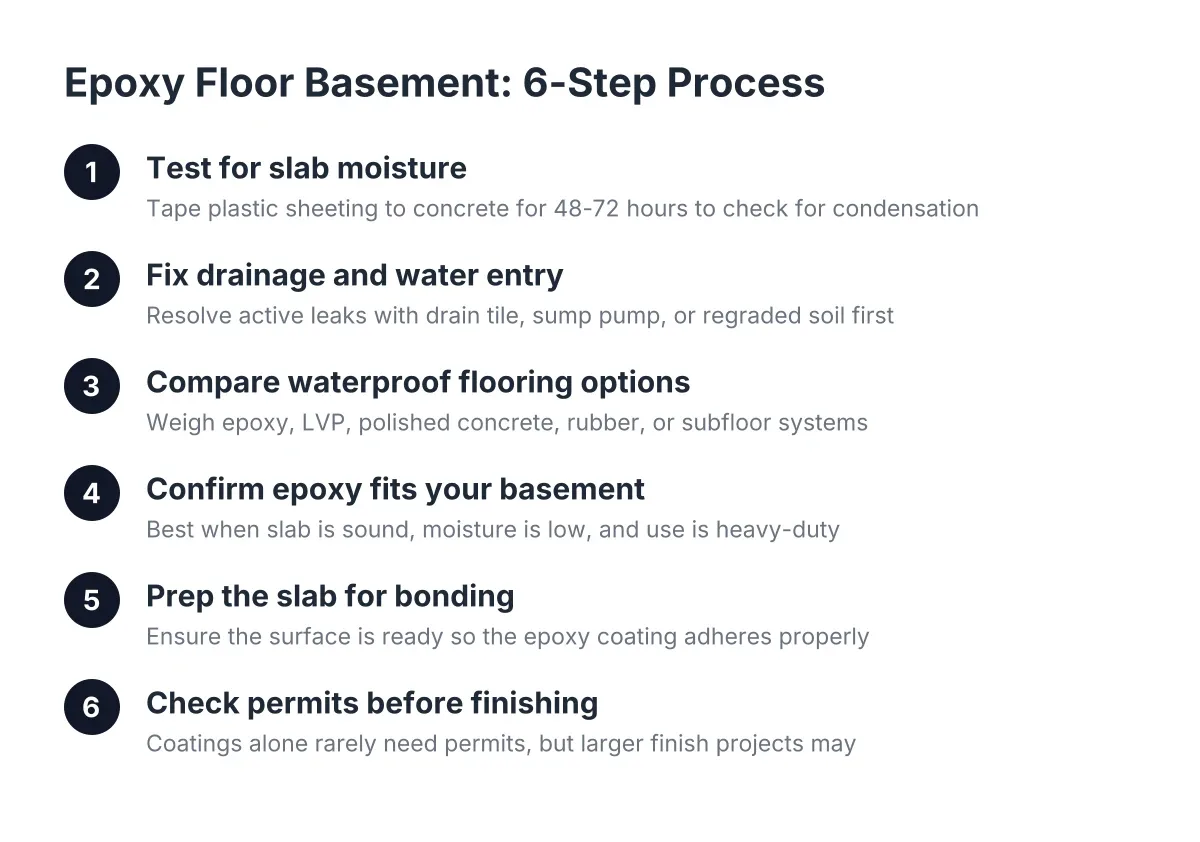
Minneapolis basements deal with spring melt, clay soil, and long wet seasons. If your slab shows dampness, efflorescence (the white chalky residue on concrete), or a musty smell, moisture has to be handled before flooring goes in. That can mean a vapor barrier, a drainage fix, or in worse cases waterproofing work that becomes its own line item. Skipping it is the expensive mistake: a floor installed over a wet slab buckles, molds, or delaminates, and then you pay for the floor twice. A simple test tells you a lot. Tape a square of plastic sheeting to the slab, wait a day or two, and check for condensation underneath.
Square Footage and Layout
More floor means more material and more labor, so a bigger basement costs more. That part is obvious. What surprises homeowners is how layout changes the math. A wide-open rectangle installs fast. A basement chopped into rooms, closets, and hallways means more cuts, more transitions, more waste, and more hours. Count your rooms and corners. If your basement layout has a mechanical room, a bathroom, and two bedrooms, expect the per-square-foot effort to run higher than one open rec room of the same size.
Subfloor and Insulation Choices
A floating subfloor or insulated subfloor panels add warmth and a moisture buffer between the concrete and your finished floor. In Minnesota, that layer is often the difference between a basement your family actually uses in January and one they avoid. It adds material and labor cost up front, but it also protects the flooring above it. If you plan to put down carpet or wood-look plank in a living space, a subfloor is worth pricing. If you are epoxy-coating a workshop floor, you skip it entirely.
Tear-Out of the Old Floor
If your basement already has flooring, someone has to remove it and haul it away. Glued-down carpet, old tile, or layers of past projects add demolition hours and disposal fees. Peel back a corner if you can. Flooring that lifts freely costs little to remove. Flooring that fights back, especially old glued vinyl or tile, adds real labor before the new floor even starts.
Cost Factor Table
| Factor | Pushes the price down when… | Pushes it up when… |
|---|---|---|
| Material choice | You pick a mid-grade vinyl plank, carpet, or a basic epoxy coating matched to how the room gets used | You choose tile, engineered wood, or premium finishes that take more labor to install |
| Slab condition | The concrete is flat, dry, and free of major cracks | The slab needs grinding, crack repair, or self-leveling compound before installation |
| Moisture | The plastic-sheet test comes back dry and there is no history of seepage | Dampness, efflorescence, or past water events mean vapor barriers or waterproofing come first |
| Size and layout | The space is one open room with few cuts and transitions | The basement is divided into multiple rooms, closets, and hallways |
| Subfloor | You skip it for a garage-style or utility space | You add an insulated subfloor for a warm, livable finished basement |
| Tear-out | The basement is unfinished bare concrete | Old glued-down flooring has to be demolished and hauled away |
How to Get an Accurate Basement Flooring Estimate
The fastest path to a real number is a free estimate from a local contractor who walks your basement in person. Here is how to make that visit count.
Have this information ready before anyone shows up:
- Rough square footage, or just the length and width of the basement
- What the space will be used for: bedroom, rec room, home gym, or office
- Any history of water, dampness, or musty smells, even years ago
- What is on the floor now, and whether you know how it was attached
- Photos of any visible cracks or uneven spots in the slab
A good quote should itemize, not lump. Look for separate line items for tear-out, slab prep, moisture treatment, subfloor, the flooring material itself, and installation labor. If a quote is one number with no breakdown, you cannot compare it to anything, and you cannot tell what happens to the price if the slab turns out worse than expected.
Estimates differ between providers for real reasons. One contractor may include a vapor barrier by default while another leaves it out to look cheaper on paper. One may plan to grind and level the slab; another may plan to float the floor over the low spots. Neither is automatically wrong, but you need to know which job you are buying. That is why comparing two or three itemized quotes tells you more than any online price chart. If you want to see how we handle the work itself, our page on basement flooring installation in Minneapolis walks through the process.
One note on a related search: people pricing basement projects often look up concrete cost per yard or reach for a cost of concrete calculator. Those tools price poured concrete for new slabs and driveways, by the cubic yard, delivered by truck. They do not price finishing a floor over an existing slab. Unless your project involves pouring new concrete, that number will not match your quote, and that mismatch confuses a lot of homeowners.
Ways to Keep the Cost Down
You do not need coupons to lower the price of basement flooring. You need scope decisions made in the right order.
- Fix moisture before you shop materials. Water damage is the expensive version of every flooring problem. A dry slab protects whatever you install and keeps the warranty conversation simple.
- Match the material to the room, not the whole basement. Put the durable, budget-friendly floor in the workout area and save the nicer material for the family room. Mixing materials by zone trims cost without making the space feel cheap.
- Do your own tear-out if the old floor comes up easily. Pulling loose carpet and hauling it out is homeowner-grade work. Grinding off glued tile is not. Ask the contractor which category yours falls into.
- Get two or three itemized quotes. Not to grind the lowest bidder down, but to see which line items differ and why. The comparison itself often reveals a cheaper approach nobody mentioned.
- Time the work in the off-season if you can. Basement work in a Minneapolis winter is indoor work, and schedules loosen when outdoor construction slows. Flexible timing sometimes buys you room on labor.
Cost Questions People Ask
How much does an epoxy basement floor cost?
Epoxy pricing hinges on prep more than the coating itself. A clean, sound slab needs light grinding and one or two coats; a stained, cracked, or previously painted slab needs heavy grinding and repair before any epoxy goes down, and that prep can outweigh the coating cost. Coating grade matters too, since a basic single-color epoxy costs less than a flake or metallic system. Get the slab inspected first, because the prep line is where epoxy quotes diverge.
Why does concrete get priced per yard, and does that apply to my basement floor?
Ready-mix concrete is sold by the cubic yard because it arrives wet in a truck, and a cost of concrete calculator estimates how many yards a slab or driveway needs. If your basement already has a slab, per-yard concrete pricing does not apply to your flooring project. It only comes into play if a section of slab is so damaged it needs to be broken out and re-poured, which your contractor can tell you during an estimate.
Is it cheaper to floor the basement during a full basement finishing project?
Usually, yes. When flooring is one line inside a larger basement remodeling job, the crew is already on site, the slab prep coordinates with framing and plumbing, and you avoid paying separate mobilization for a standalone job. Flooring a basement after the walls and bathroom are done means working around finished surfaces, which slows the work.
Do I need a permit for basement flooring in Minneapolis?
Flooring alone typically does not trigger a permit, but the projects around it often do. Adding a basement bathroom, moving walls, or running new electrical as part of a basement renovation involves permits and inspections. A local contractor who works in Minneapolis should tell you up front what your project requires; if they wave the question off, that is a warning sign, not a savings.
The Bottom Line
The cost of basement flooring comes down to material, slab condition, and moisture, and no honest number exists until someone looks at your actual floor. Gather two or three itemized quotes, ask each one how they handle slab prep and moisture, and compare line by line. A free estimate costs you nothing and replaces guesswork with a number you can actually budget around.
If you need basement finishing, Minneapolis Basement Finishing Pros can help.
Prefer to talk it through? Call (651) 758-8806 — a quick call is usually the fastest way to get a straight answer for your situation.