
Basement Flooring — Complete Guide
Your basement flooring choice will make or break your finished basement, especially in Minneapolis where slabs sit against clay soil that holds water most of the year. This guide walks you through basement flooring ideas that actually work below grade, from waterproof options like luxury vinyl and epoxy to the subfloor systems that keep everything dry underneath. You will learn how moisture shapes every material decision, how the main options compare on comfort and durability, and what realistic budgets look like per square foot. By the end, you will know which flooring paths fit your basement and which ones to cross off the list before you spend a dime.
What You'll Find in This Guide
- Epoxy Floor Basement Guide: Waterproof Flooring Steps for Minneapolis Homes
- Basement Flooring Terms Explained: A Plain-English Glossary
- Basement Flooring Installation in Minneapolis, MN
- How Much Does Basement Flooring Cost?
- How to Measure Your Basement Floor: Concrete Slab Calculator Basics
- Epoxy vs. Polished Concrete vs. Tile: Choosing Basement Flooring That Survives Minneapolis Moisture
- Basement Flooring Ideas That Survive Minneapolis Moisture and Freeze-Thaw
Why Basement Flooring Ideas Start with Moisture, Not Style
Most flooring advice online skips the one thing that matters most below grade: water. Your Minneapolis basement slab sits against soil that stays damp through spring thaw and summer storms. Even a basement that has never flooded pushes water vapor up through the concrete constantly. That vapor is the reason a beautiful floor can buckle, cup, or grow mold within a year of installation.
This means your first decision is not carpet versus vinyl. It is understanding how much moisture your slab produces and choosing a system that handles it. Some materials, like luxury vinyl plank and epoxy, tolerate vapor well on their own. Others, like engineered wood or carpet, need a moisture barrier or a full subfloor system between them and the concrete. Skipping that layer to save money is the most expensive shortcut in basement finishing.
For a deeper look at which materials handle our conditions, start with our guide to basement flooring ideas that survive Minneapolis moisture and freeze-thaw. It explains why advice written for basements in Arizona or Georgia does not transfer here.
How to Read Your Slab Before You Choose Basement Flooring
Before you fall in love with a product, test your slab. A simple plastic sheet taped to the concrete for 48 hours tells you a lot. Condensation under the plastic means active vapor transmission, and that finding narrows your options immediately. Additionally, look for white powdery residue called efflorescence, hairline cracks, and low spots where water could pool.
Moisture control matters for health as well as durability. According to the EPA, controlling moisture is the key to controlling mold indoors, and a basement floor that traps vapor gives mold exactly what it needs. As a result, the right flooring system protects your family's air quality, not just your investment.
With this in mind, treat any contractor who quotes flooring without asking about moisture as a red flag. The material list should follow the moisture assessment, never the other way around.
Comparing Your Main Options: Vinyl, Carpet, Epoxy, and Tile
Once you understand your slab, the material comparison gets much simpler. In practice, four families of flooring cover most Minneapolis basements, and each trades off comfort, durability, and moisture tolerance differently.
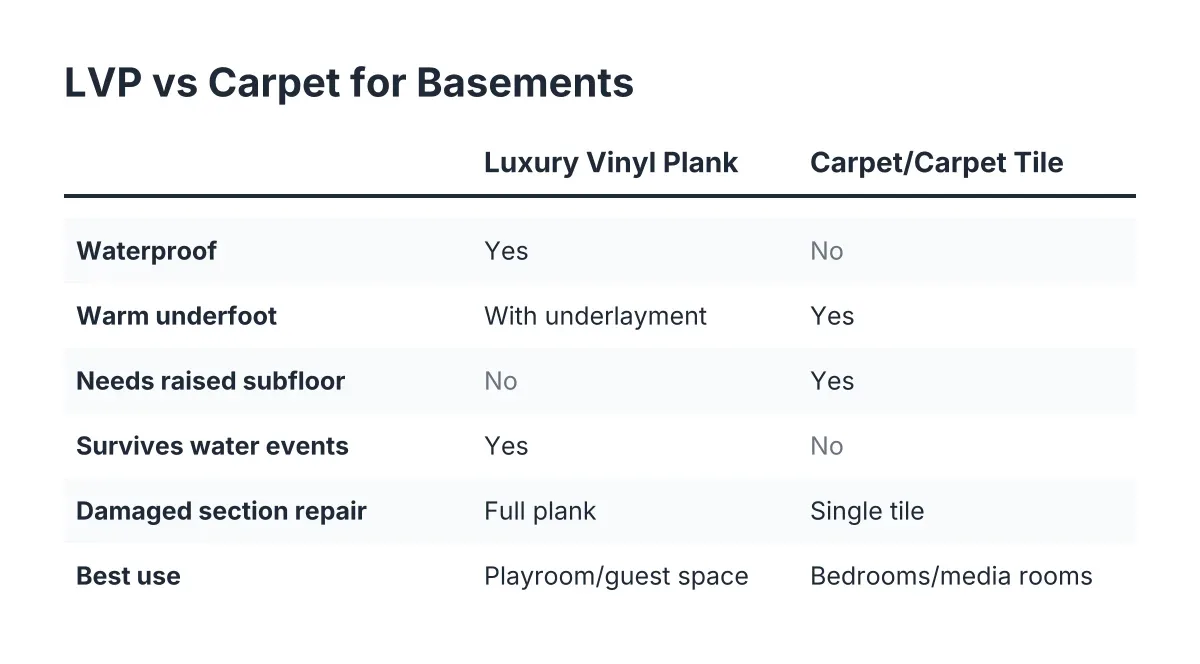
Luxury vinyl plank has become the default choice for finished basements, and for good reason. It is fully waterproof, warm enough underfoot with the right underlayment, and looks convincingly like wood. However, it still needs a flat, dry slab to perform well. Carpet remains the comfort champion for family rooms and play spaces. That said, carpet in a basement demands either a very dry slab or a subfloor system that lifts it off the concrete. The vinyl plank versus carpet decision usually comes down to how you will use the room and how much moisture your slab produces.
Hard-Surface Options That Go Straight Over Concrete
Epoxy, polished concrete, and tile take a different approach. Instead of covering the slab, they become the finished surface or bond directly to it. For example, a properly installed epoxy coating seals the concrete and shrugs off water from above and below. Our comparison of epoxy versus polished concrete versus tile breaks down where each one wins.
Epoxy deserves a closer look if you want a workshop, gym, or laundry area. Beyond that, it works well in basements with a history of minor seepage, because there is nothing organic for water to ruin. If you are curious about the process, our step-by-step epoxy floor basement guide walks through it from moisture testing to final coat.
Do not overlook subfloor systems, either. These raised panels create an air gap between the concrete and your finished floor. Consequently, they let you install carpet or engineered flooring in basements that would otherwise rule those materials out. They also add warmth, which matters when your slab hovers near 55 degrees all winter.
Budgeting for Basement Flooring: Costs, Measurements, and Payback
Flooring budgets fall apart for two reasons: homeowners measure wrong, or they price the material without pricing the prep. To put it simply, the slab underneath drives cost as much as the product on top. A cracked or out-of-level slab needs grinding or self-leveling compound before anything goes down. A damp slab needs a vapor barrier or subfloor system. These line items are why two identical basements can produce quotes hundreds or thousands of dollars apart.
Start with accurate numbers. Our guide to measuring your basement floor with a concrete slab calculator shows you how to get square footage right, including closets, stair landings, and the waste factor installers build in. From there, our basement flooring cost guide breaks down realistic per-square-foot pricing by material and slab condition.
For context on the bigger picture, Angi reports that an average basement remodel runs $30 to $75 per square foot, with flooring as one slice of that total. Knowing where flooring sits inside the full project budget helps you decide where to spend and where to save.
What the Investment Returns
The payback on a finished basement is stronger than most homeowners expect. The National Association of Realtors found that basement finishing recovers 64% of its cost at resale, one of the highest returns among the 20 projects in its Remodeling Impact Report. Just as important, the same report gave basement finishing a joy score of 9.5 out of 10 from homeowners who completed the project. In other words, you get real living space now and a meaningful share of your money back later.
For a growing family, that math usually beats moving. A durable, moisture-smart floor is the foundation of that added space, literally. If terms like "vapor emission rate" or "dimple mat" start piling up in your quotes, our plain-English basement flooring glossary decodes them. And when you are ready to talk installation, our basement flooring installation service in Minneapolis covers luxury vinyl, tile, and engineered options as part of a full finishing project.
Ready to Get Started?
You now have a clear framework: test the moisture, match the material to your slab, and budget for prep as well as product. If you want a second set of eyes on your basement before you commit to any flooring, we offer free estimates with straight answers on what will work in your specific space. Reach out and tell us about your basement, and we will help you turn these basement flooring ideas into a floor that lasts.