Basement Flooring Ideas That Survive Minneapolis Moisture and Freeze-Thaw
Most basement flooring ideas you find online were written for basements in Arizona or Georgia. Minneapolis basements play by different rules. Our concrete slabs sit against soil that freezes solid, thaws in spring, and pushes moisture up through the floor for months. Snowmelt in March, humid air in July, and a slab that stays around 55 degrees year-round all work against the wrong flooring choice.
That matters more than color or style. Pick a floor that can't handle moisture from below and you'll be tearing it out in three years, sometimes with mold behind it. If you're finishing a basement bedroom or getting a house ready to sell, a failed floor is exactly the kind of surprise that shows up in an inspection.
So here's the list we walk homeowners through at the kitchen table: seven basement flooring ideas that hold up in Minneapolis conditions, plus two steps that matter more than the flooring itself.
1. Start With a Moisture Test, Not a Flooring Sample
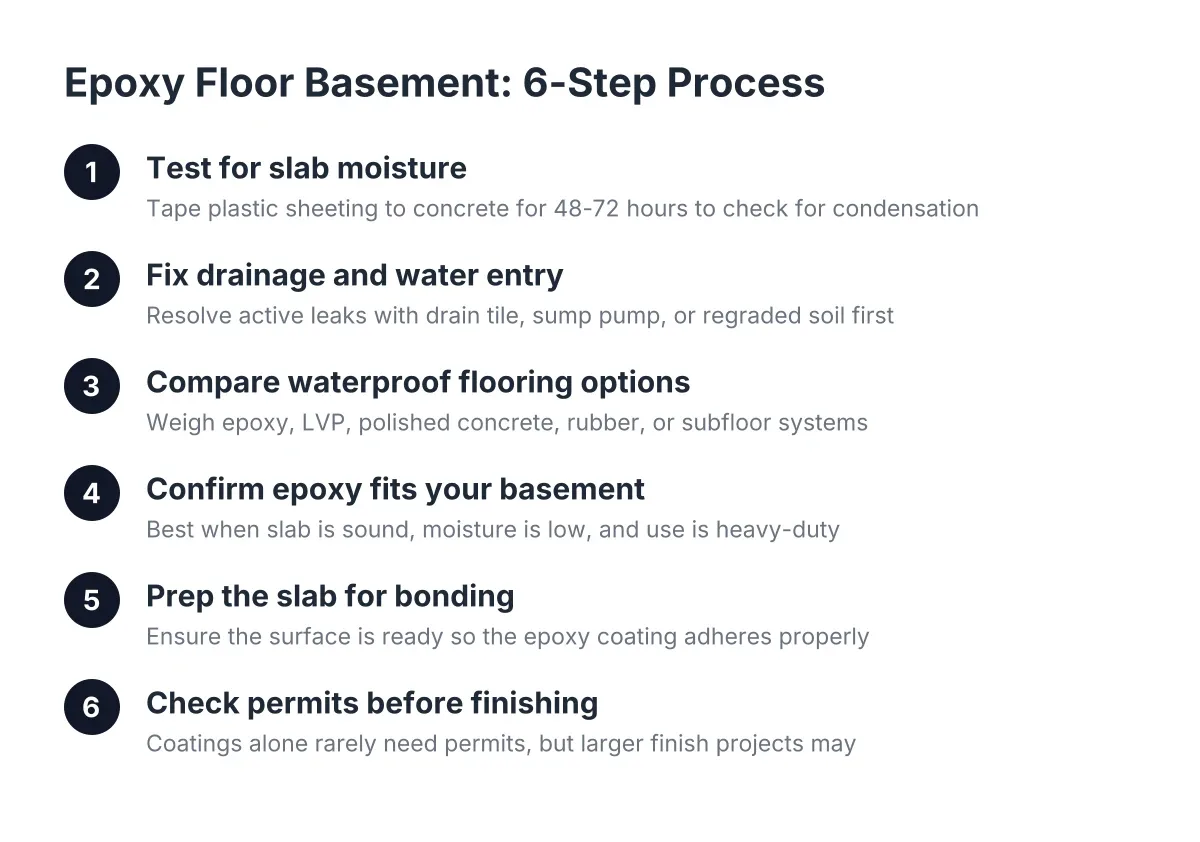
Before you fall in love with any floor, tape a two-foot square of plastic sheeting to your bare concrete and leave it for 48 hours. If you peel it back and find condensation or a dark spot on the slab, water vapor is moving up through the concrete. That result should drive every flooring decision you make.
A lot of Minneapolis slabs, especially in homes built before the 1980s, were poured without a vapor barrier underneath. Moisture doesn't need a visible leak to ruin a floor; steady vapor pressure alone will curl glue-down planks and feed mold under carpet pad. Test first. It costs a few dollars and can save you the price of a full tear-out.
2. Luxury Vinyl Plank: The Workhorse for Basement Flooring Over Concrete
If we had to pick one answer for most Minneapolis basements, this is it. Luxury vinyl plank (LVP) is fully waterproof, floats over concrete without glue, and handles the slab's temperature swings without gapping or buckling. It looks like wood, feels warmer underfoot than tile, and shrugs off a spilled water heater pan or a wet spring.
In the vinyl plank vs carpet basement debate, vinyl wins on survivability. If your basement ever takes on water, LVP can often be dried out and reinstalled. Carpet usually goes in the dumpster. For a rental-ready lower level or a legal basement bedroom you plan to count at appraisal, vinyl plank is the low-risk pick.
One caution: cheap thin vinyl telegraphs every dip and hump in an old slab. Budget for floor leveling on uneven concrete, or the planks will click apart at the seams.
3. A Subfloor System: The Upgrade Under the Floor Nobody Sees
Basement subfloor systems are raised panels, usually plywood or OSB bonded to a dimpled plastic base, that lift your finished floor about an inch off the concrete. The air gap lets the slab breathe and keeps minor moisture from ever touching your flooring. It also breaks the thermal connection with that 55-degree concrete, which is the difference between a floor that feels fine in January and one that feels like a skating rink.
For a basement bedroom, this is the comfort upgrade we recommend most often. It adds cost per square foot, but it protects everything above it. If your plastic-sheet test showed moisture, or if you want carpet downstairs, a subfloor system is close to mandatory in this climate.
4. Carpet Tiles: The Kid-Friendly Compromise
Wall-to-wall carpet over bare basement concrete is the choice we talk people out of most. However, carpet tiles solve most of the problem. They're one of the better options for kids because a spill or a wet winter boot ruins one 24-inch square, not the whole room. You pull the tile, dry it or replace it, and move on.
Pair carpet tiles with a subfloor system or a quality vapor-rated pad and you get warmth underfoot without trapping moisture against the slab. For a playroom or media room in a finished basement, this is the practical middle ground between comfort and caution.
5. Polished or Epoxy-Coated Concrete: Budget-Friendly and Nearly Indestructible
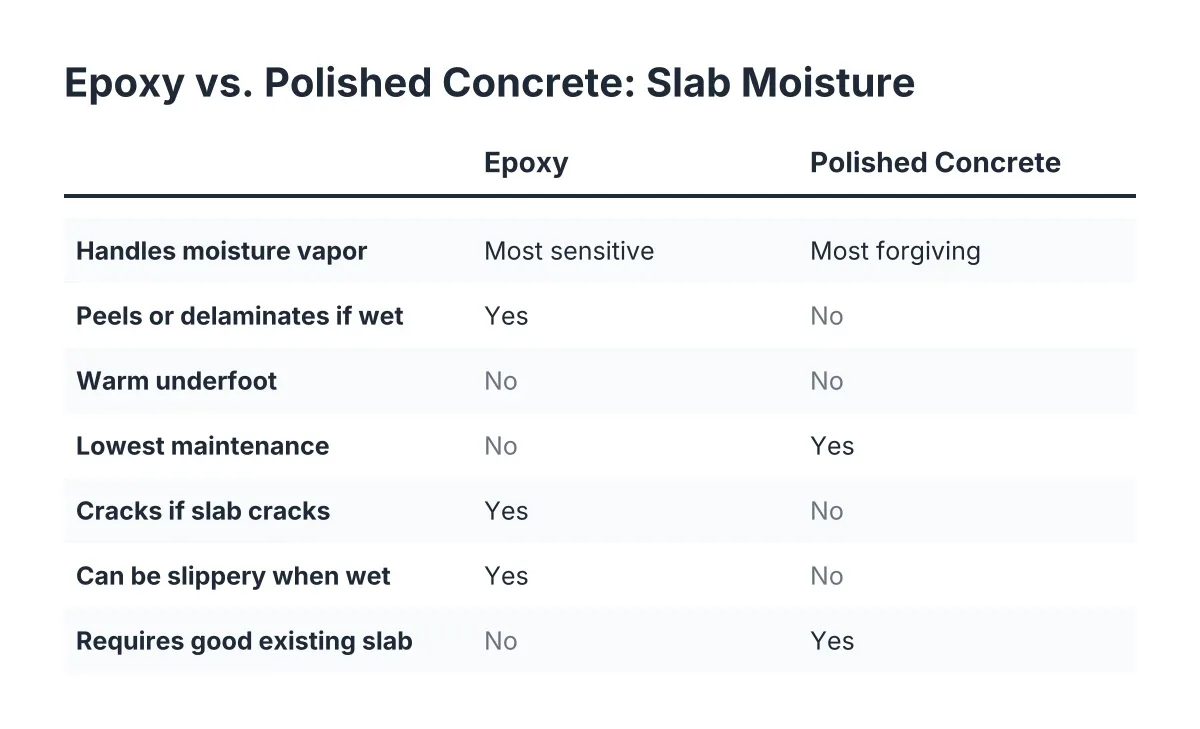
Among flooring options on a budget, working with the slab you already have is hard to beat. An epoxy coating or a polished and sealed finish turns the concrete itself into the floor. Nothing to buckle, nothing to soak, nothing to grow mold. Epoxy handles Minneapolis freeze-thaw conditions well because there's no separate flooring layer for moisture to attack.
The trade-offs are honest ones: it's hard, it's cold, and it echoes. Area rugs fix most of that. For a workout room, workshop, or a walkout basement that sees muddy traffic, epoxy is a smart low-cost play. For a bedroom, most homeowners want something warmer.
6. Porcelain Tile: The Permanent Choice for Basement Bathrooms
If your basement remodel includes a basement bathroom, porcelain tile is the standard for good reason. It's waterproof, it bonds directly to concrete, and it will outlast every other floor on this list. In a laundry area or near a walkout door where snow gets tracked in, tile takes the abuse without complaint.
The catch is comfort. Tile over a Minneapolis slab is cold ten months a year, so many homeowners add electric radiant heat mats under the tile in bathrooms. That adds cost, but in a below-grade bathroom it changes the room from tolerable to genuinely pleasant.
7. Engineered Wood: Possible, but Only With Homework
Solid hardwood does not belong below grade in Minnesota; seasonal humidity swings will cup and gap it. Engineered wood, with its plywood core, can work in a dry basement over a proper vapor barrier or subfloor system. It's the choice for homeowners who want real wood underfoot and are willing to manage the risk.
Be honest with yourself here. If your moisture test showed any vapor, or your basement has ever taken water, skip wood entirely. This is also a spot where a professional assessment pays for itself; a contractor who knows local basements can tell you whether your slab and drainage can support wood before you spend the money.
How to Compare Popular Basement Flooring Options at a Glance
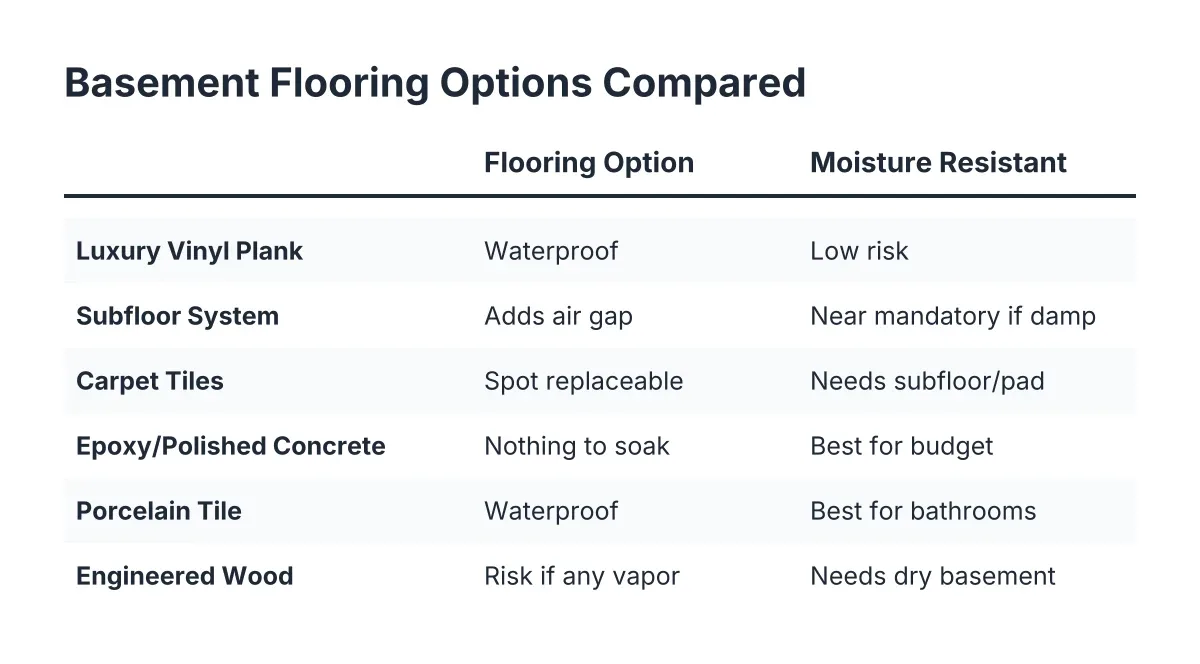
Here's how the main options stack up for a typical Minneapolis basement:
- Luxury vinyl plank: Waterproof, warm-ish, forgiving. Best all-around choice for bedrooms and living space.
- Subfloor system plus flooring: The warmest and safest build-up; adds an inch of height and cost.
- Carpet tiles: Comfortable and replaceable square by square; keep them off bare concrete.
- Epoxy or sealed concrete: Cheapest durable option; cold and hard without rugs.
- Porcelain tile: Waterproof and permanent; best in basement bathrooms, ideally with radiant heat.
- Engineered wood: Attractive but risky; only for verified-dry basements with a vapor barrier.
As a rough illustration, say a homeowner is finishing a 700-square-foot lower level to add a legal bedroom and family room before listing the house. In that scenario, sealed concrete might run a few dollars per square foot, mid-grade LVP somewhere in the $4 to $8 range installed, and a subfloor system under carpet or vinyl could add $3 to $6 more per square foot. Those are illustrative estimates, not quotes; slab condition and layout change the math on every job. For the full project, an average basement remodel costs between $30 and $75 per square foot, according to Angi.
What Flooring Has to Do With Passing Inspection
If you're finishing a basement bedroom, flooring itself is rarely what fails an inspection; egress, ceiling height, and permits are the usual sticking points. However, the floor still matters to the outcome. Moisture damage under a new floor is the kind of thing that surfaces in a pre-listing inspection years later, right when you can least afford a surprise.
Therefore, do the work in the right order. Solve moisture first, pull the permits your project needs, and then pick basement flooring that fits how you'll use the room. Any basement flooring installation that's part of a permitted finishing project should be documented, so a future buyer's inspector sees a clean paper trail instead of red flags.
There's also a payoff argument for doing it right. The National Association of Realtors Remodeling Impact Report found that 64% of basement finishing costs are recovered at sale, one of the highest returns among the 20 projects studied. The same report gave basement finishing a 9.5 out of 10 joy score from homeowners. A floor that survives Minneapolis winters is a big part of both numbers.
The Bottom Line for Minneapolis Basements
The best basement flooring ideas for this climate all start from the same rule: assume moisture, plan for it, and choose materials that don't care about it. Test your slab, put a vapor barrier or subfloor system between the concrete and anything organic, and match the material to the room. Vinyl plank for living space, tile for the bathroom, epoxy for the utility zones, and carpet tiles where kids land.
Get those calls right and your finished basement will still look finished in ten years, through every freeze-thaw cycle Minnesota throws at it.
If you need basement finishing, Minneapolis Basement Finishing Pros can help.
Prefer to talk it through? Call (651) 758-8806 — a quick call is usually the fastest way to get a straight answer for your situation.