Epoxy vs. Polished Concrete vs. Tile: Choosing Basement Flooring That Survives Minneapolis Moisture
If you are comparing epoxy basement flooring against polished concrete and tile, you are asking the right question for a Minneapolis basement. All three go directly over your concrete slab, all three shrug off water better than carpet or wood, and all three handle the freeze-thaw moisture cycle that soaks through foundations here every spring. The differences come down to moisture vapor, comfort underfoot, cost, and what happens if your slab ever cracks. This guide walks you through the decision step by step, the same way we would at your kitchen table before any work begins.
One note before you start: flooring is usually the last decision in a basement finishing project, not the first. If you are also adding a bedroom, a basement bathroom, or moving walls, those changes need permits and inspections in Minneapolis. Flooring itself rarely triggers a permit, but the room around it often does. Sort that out first so you never pay for a floor and then tear it up to fix something behind a wall.
Step 1: Test Your Slab for Moisture Before You Pick Anything
Every hard-surface basement floor lives or dies on moisture vapor. Minneapolis basements sit below grade in clay-heavy soil that holds water. Even a slab that looks bone dry can push water vapor up through the concrete year-round.
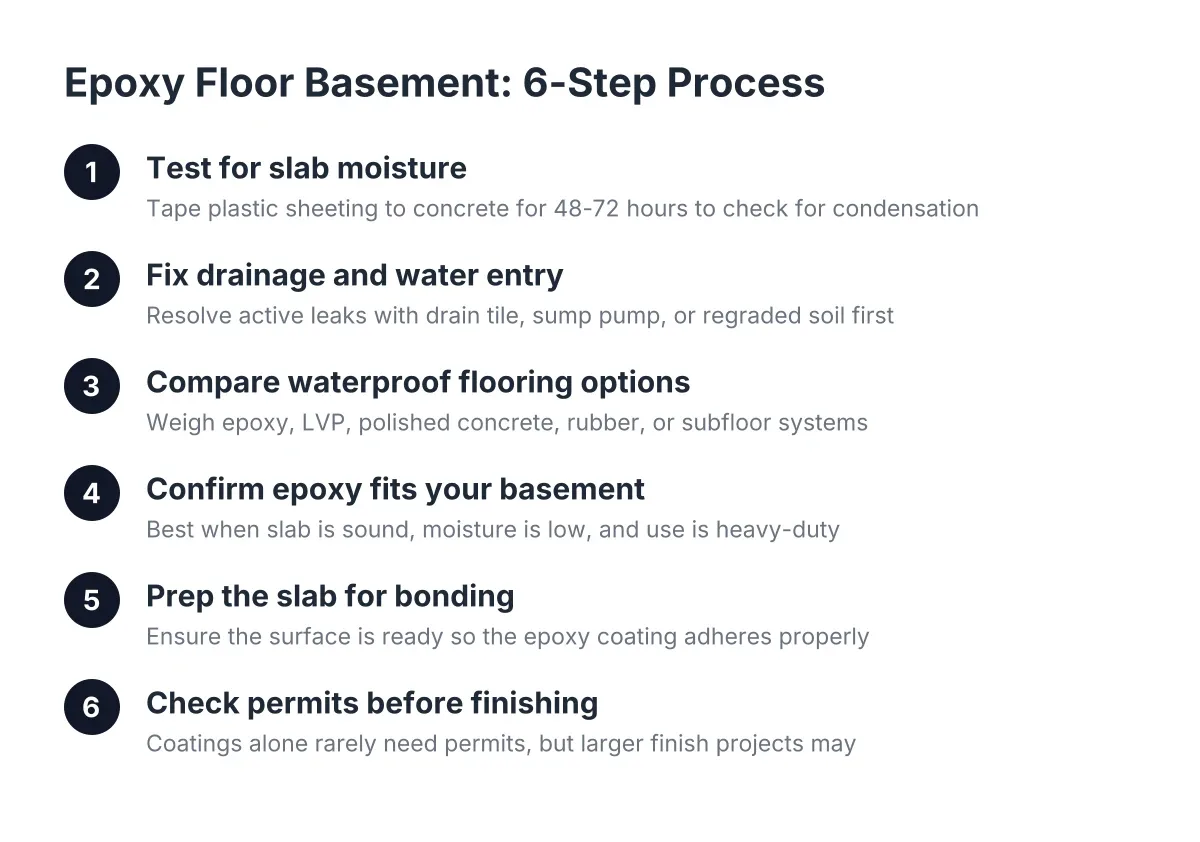
Here is the simple homeowner test. Tape a two-foot square of clear plastic sheeting to the slab, seal all four edges with duct tape, and leave it for 48 to 72 hours. If you find condensation under the plastic or a dark spot on the concrete, your slab transmits moisture.
This result matters for all three options, but not equally:
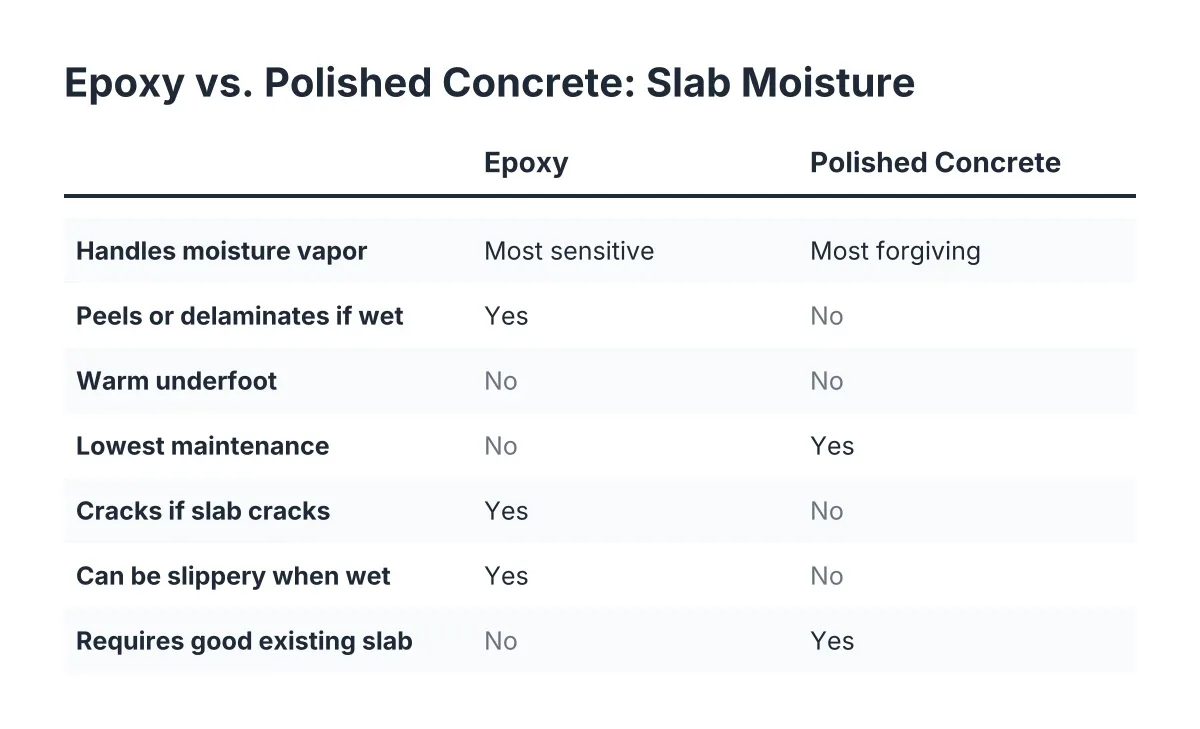
- Epoxy is the most sensitive. Moisture vapor pushing up under an epoxy coating causes bubbling, peeling, and delamination. A wet slab usually needs a moisture-mitigating primer first, which adds cost.
- Polished concrete is the most forgiving. It is the slab itself, so vapor passes through without lifting anything.
- Tile sits in the middle. Porcelain tile and modern thinset tolerate vapor well, but efflorescence (white mineral deposits) can telegraph through grout on a wet slab.
If your test shows heavy moisture, deal with the source first. Grading, gutters, and downspout extensions solve more Minneapolis basement moisture problems than any coating ever will. No floor is a substitute for waterproofing.
Step 2: Compare How Each Floor Handles a Below-Grade Slab
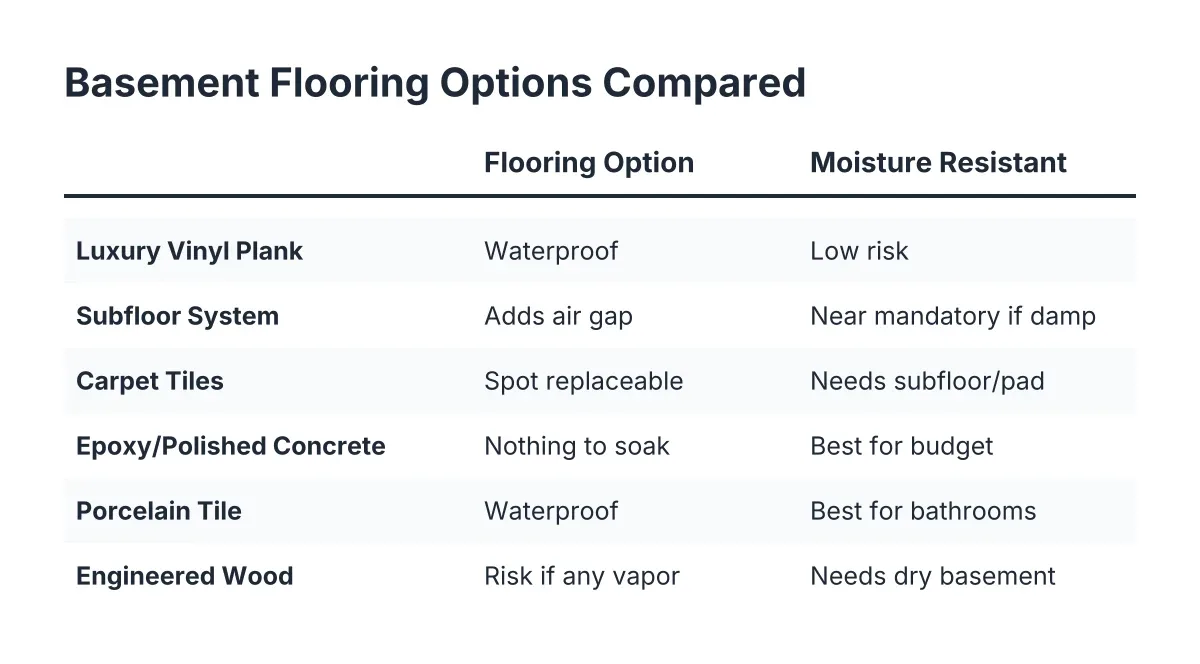
All three options qualify as waterproof basement flooring in the practical sense: a washing machine overflow or a spring seep will not destroy any of them. The differences show up in day-to-day living.
What epoxy basement flooring does well, and where it struggles
Epoxy basement flooring is a resin coating, usually two or three layers, that bonds to the concrete and creates a hard, non-porous surface. Done right, it seals the slab, resists stains, wipes clean, and can look like anything from a solid gray to decorative flake or metallic finishes.
The strengths are real. Epoxy has no seams or grout lines to trap moisture. It handles workshop use, exercise equipment, and pet accidents without complaint. For a hobby room or a utility-heavy space, it is hard to beat.
The trade-offs are just as real. Epoxy is hard and cold underfoot, which matters if you are planning single-level living downstairs or a guest suite for an aging parent. It can be slippery when wet unless the installer adds anti-slip grit. Surface prep is everything; a poorly ground slab or a skipped moisture primer means peeling within a few years. And if the slab cracks from settling, the epoxy cracks with it.
Polished concrete: the slab itself, refined
Polished concrete is not a coating. An installer grinds the existing slab with progressively finer diamond pads, applies a densifier, and polishes to the sheen you want. There is nothing to peel because there is nothing on top.
That makes it the lowest-maintenance option of the three and the best performer on a slab with moisture vapor. The downsides: your existing slab has to be in decent shape. Older Minneapolis homes, especially those with slabs poured 60 or more years ago, often have pitting, old patch jobs, or embedded stains that polishing will highlight rather than hide. It is also the coldest and hardest surface of the three, and dropped glassware does not survive it.
Tile: the most finished look, the most labor
Porcelain tile over a proper uncoupling membrane gives you the most residential, upstairs-quality look of the three. Wood-look porcelain planks in particular read as a finished living space rather than a converted basement. Grout is the weak point; it needs sealing and will show wear in high-traffic paths.
Tile costs the most in labor and takes the longest to install. However, it pairs naturally with in-floor heat, which brings us to the comfort question.
Step 3: Factor In Cold, Because This Is Minneapolis
A basement slab here sits at roughly 50 to 55 degrees for much of the year. Epoxy, polished concrete, and tile all transmit that cold directly to your feet. None of the three is warm on its own.
Therefore, decide how the room will be used before you pick the surface. Suppose a couple in their early sixties is finishing the basement as a guest suite so a parent can move in next year. In that scenario, we would steer them away from bare epoxy or polished concrete in the bedroom and sitting area. An electric radiant mat under tile, or a subfloor system with vinyl plank, keeps the space livable in January. We might still recommend epoxy in the adjacent laundry and mechanical area, where durability matters more than bare feet.
Ways to manage the cold with each option:
- Epoxy or polished concrete: add large area rugs in seating and sleeping zones, and keep the hard surface in traffic paths and utility areas.
- Tile: install electric radiant heat mats under the tile. This is the only one of the three that commonly gets in-floor heat in a retrofit.
- Any option: address rim-joist insulation and basement wall insulation during the remodel, since the floor is only part of why basements feel cold.
Also think about hardness, not just temperature. For aging-in-place plans, every one of these surfaces is unforgiving in a fall. That is a legitimate reason some homeowners choose luxury vinyl plank or carpet tile over a subfloor instead, even though this article compares the three hard-surface options.
Step 4: Run the Numbers on Cost and Lifespan
As illustrative 2026 estimates for the Minneapolis market, not quotes: professionally installed epoxy commonly runs in the range of $4 to $10 per square foot depending on the system and how much slab prep the concrete needs. Polished concrete tends to land in a similar $4 to $12 range, driven by slab condition and sheen level. Porcelain tile with membrane and installation typically runs higher, often $10 to $20 per square foot.
So the epoxy basement floor cost advantage is real at the low end, but it narrows fast once a damp slab needs a moisture-mitigating primer or heavy grinding. Get the moisture test done before you trust any per-square-foot number.
For context on the whole project, an average basement remodel costs between $30 and $75 per square foot according to Angi, so flooring is one line item among many. It is also money most homeowners do not regret. Homeowners gave basement finishing a joy score of 9.5 out of 10 in the NAR Remodeling Impact Report, according to the National Association of Realtors. If resale is part of your thinking, the same National Association of Realtors report found 64% of basement finishing costs recovered at sale, among the highest of the 20 projects studied.
Lifespan follows a similar pattern. Polished concrete can last as long as the slab. Tile lasts decades with grout maintenance. Epoxy typically needs a recoat in 10 to 20 years in residential use, sooner if prep was poor.
Step 5: Decide Whether Epoxy Basement Flooring Is a DIY Job or a Pro Job
Big-box epoxy kits make this look like a weekend project. For a Minneapolis basement, we would push back on that for one reason: prep. A durable epoxy floor needs the slab mechanically ground or shot-blasted, cracks filled, moisture tested, and the right primer chosen for the vapor reading. Roll-on kits over a swept slab are why so many people report peeling epoxy within two years.
Polished concrete is not a DIY option at all; the grinding equipment alone rules it out. Tile is DIY-possible for a patient homeowner, but membrane selection and flatness tolerances trip up first-timers on old slabs.
There is also a code angle worth naming, since it worries a lot of homeowners. Replacing or coating basement flooring generally does not require a permit in Minneapolis. But the moment your project includes a new basement bathroom, moved walls, new wiring, or converting a room to a legal bedroom, permits and inspections apply. A bedroom conversion in particular has requirements beyond flooring, including proper egress. If that is your situation, talk to a contractor or the city before spending a dollar on floors, so the finish work happens after the inspected work, not before it.
Step 6: Match the Floor to the Room and Make the Call
Here is the short version of the comparison:
- Choose epoxy for workshops, laundry areas, exercise rooms, and utility-heavy spaces where durability and easy cleanup matter more than warmth or a residential look. Insist on ground prep and a moisture test.
- Choose polished concrete if your slab is in good shape, you want the lowest maintenance floor available, and you like the modern look. Skip it if the slab is heavily patched or pitted.
- Choose tile for finished living areas, guest suites, and any basement bathroom, especially if you want in-floor heat under it.
Many finished basements end up with two of the three. Epoxy in the mechanical and laundry zone, tile in the bathroom, and either polished concrete or a warmer flooring in the living space is a common and sensible split.
One honest limitation: no article can read your slab. Moisture readings, slab flatness, and crack activity change the right answer from house to house, and an on-site look is the only way to know whether your concrete is a good candidate for epoxy or polishing. If your slab shows active water intrusion rather than just vapor, fix the water problem first with a professional before any flooring decision, because every option on this list will hide a problem you need to see.
If you need basement finishing, Minneapolis Basement Finishing Pros can help.
Prefer to talk it through? Call (651) 758-8806 — a quick call is usually the fastest way to get a straight answer for your situation.