Basement Contractor vs. General Contractor: Who Finishes Basements Right?
If your basement sits half framed and stalled, you have probably typed both "basement contractor" and "general contractor" into a search bar and wondered which one to call. The basement contractor general contractor question matters more than most homeowners think, especially in Minneapolis where old foundations, moisture, and cold slabs punish shortcuts. When you are finishing a half-finished basement that someone else started, the choice between specialists becomes even sharper. Here is a straight answer from a local operator's point of view, plus seven things to check before you hire anyone to pick up where the last person left off.
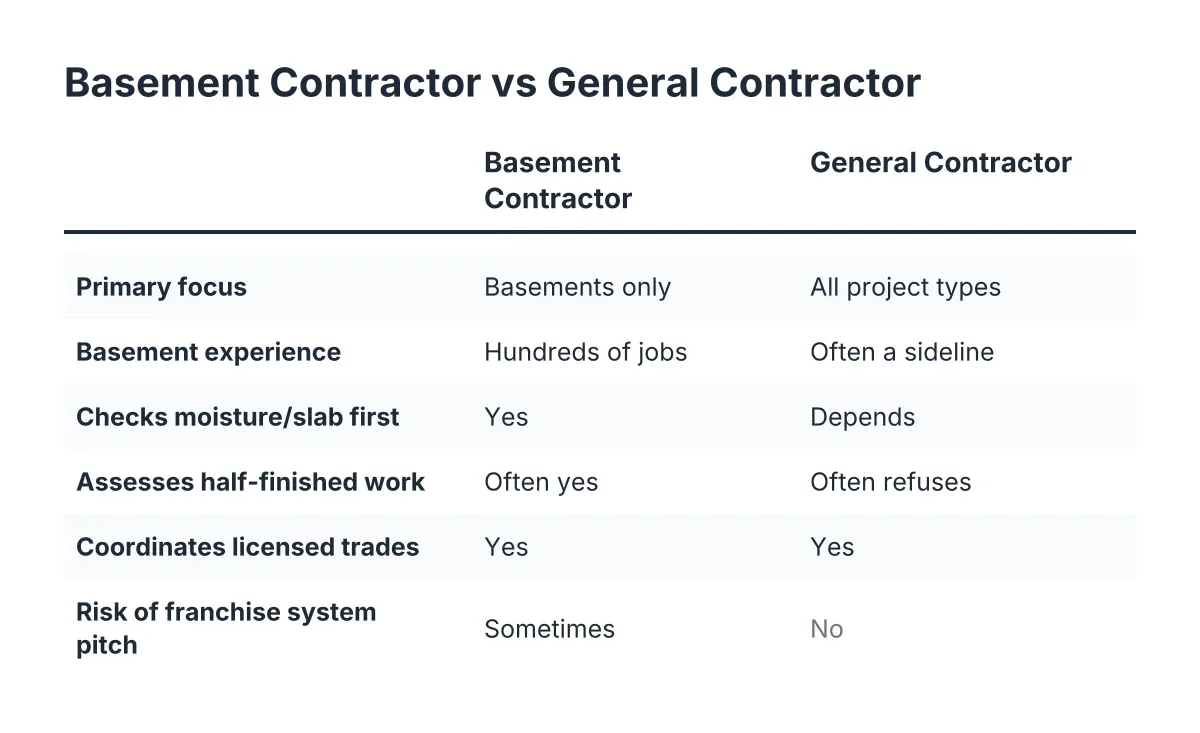
First, the short version. A general contractor manages many kinds of projects: kitchens, additions, decks, basements, whatever comes through the door. A basement finishing contractor does one thing over and over: turning unfinished or half-finished basements into livable space. Neither title guarantees quality. What matters is whether the person in front of you knows basements, knows Minneapolis conditions, and will actually finish the job.
1. Know What a Basement Contractor and General Contractor Actually Do
A basement contractor is a specialist; a general contractor is a project manager who hires and coordinates trades. A basement specialist has seen hundreds of concrete slabs, damp walls, low ceilings, and awkward stair landings. Additionally, a general contractor may be excellent, but a basement might be the third-most-common thing they do.
That difference shows up in the details. Basement work is mostly about moisture, layout, and code below grade. A specialist walks in and checks the slab, the rim joists, and the drainage before talking about paint colors. In addition, both should still bring in a licensed electrician and HVAC contractor; those trades need their own licensing and skill no matter who runs the job.
Neither answer in the basement contractor general contractor debate is automatically right. A sharp local general contractor who finishes basements often beats a distracted specialist. But if basements are a sideline for the company you are calling, ask harder questions before you sign.
2. Watch Out for Franchise Basement Systems That Standardize Everything
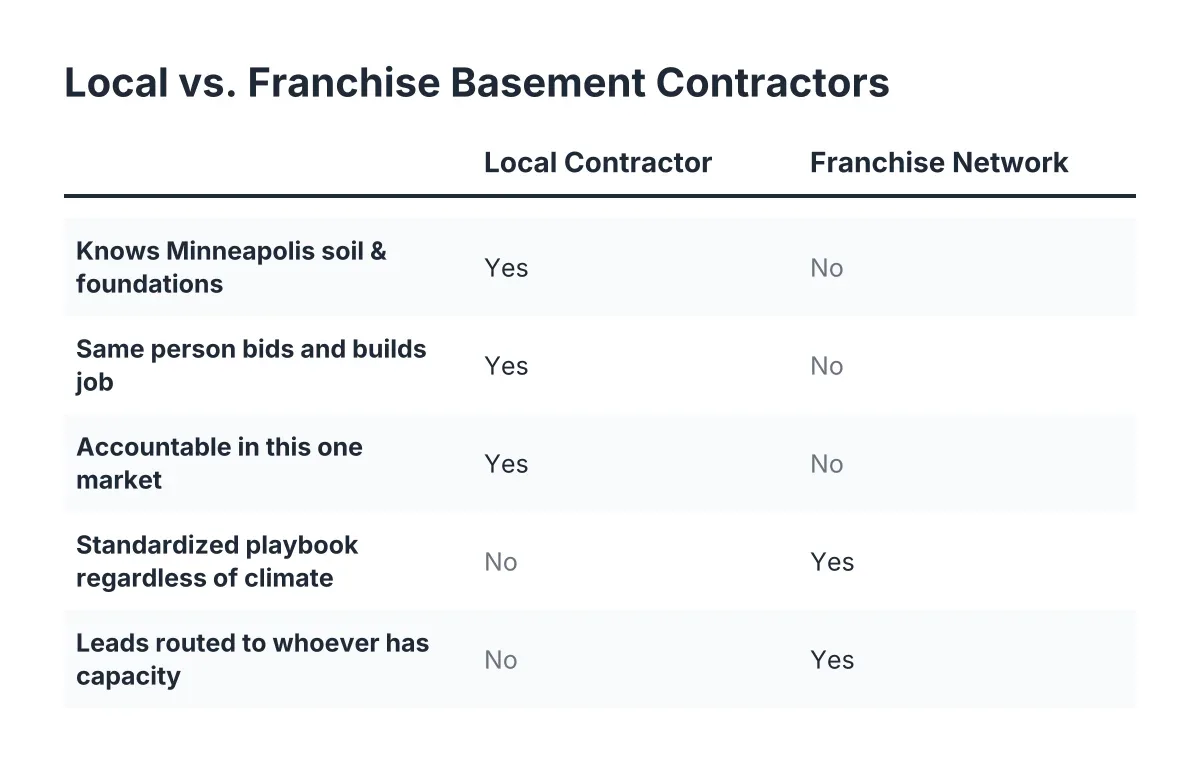
National basement-finishing networks sell a system: standardized wall panels, one flooring lineup, and a sales process that routes your lead to whoever is on call that week. That model works fine in some markets. It works less well in Minneapolis, where a 1920s stone-and-block foundation and a 1990s poured wall need different answers, not the same panel kit.
The tell is the pitch. If the first visit is a two-hour presentation about a proprietary wall product before anyone measures moisture or looks at your existing framing, you are buying a system, not a solution. However, a local contractor who knows Minneapolis basements should spend that first visit looking at your slab, your mechanicals, and what the last owner left behind.
Standardization also cuts the other way for landlords. Suppose you own a duplex and a single-family rental in the inner-ring suburbs and want durable, low-maintenance finishes across both. A local operator can spec what each building actually needs; a franchise sells you the same package twice.
3. Assessing the Half-Finished Basement Someone Else Started
This is the question that separates finishers from salespeople. Many contractors will not touch a half-finished basement. They want a clean slate because it is easier to price and easier to warranty. If you inherited framed walls from a previous owner, or your own DIY project stalled after the first weekend, you need someone willing to assess what is there.
An honest assessment sorts the space into three buckets: keep, fix, or tear out. For example, straight, dry framing set off the concrete can often stay. Wiring is a different story; exposed non-metallic cable run in ways the electrical code does not allow needs correction, and according to the National Electrical Code (NFPA 70), running that cable inside conduit in damp locations is against code. One assembly usually cannot be saved: framed walls with insulation stuffed directly against the concrete tend to trap moisture, and it is often better to tear that out and start over than to build on top of it.
Be wary of two extremes. A contractor who insists everything must go without explaining why may be padding the job. A contractor who says everything is fine without opening a wall or checking a junction box is not looking hard enough.
4. Make Moisture the First Conversation, Not the Last
In Minneapolis, moisture decides whether a finished basement lasts. Spring thaw, summer humidity, and freeze-thaw cycles all push water at your foundation. Any contractor, specialist or general, should talk about waterproofing and vapor control before talking about basement flooring or trim.
Ask specifically how they handle the slab and the walls. For instance, a vapor barrier under a concrete slab exists to block ground moisture from moving up into the concrete, according to W. R. Meadows. If your slab never got one, that changes which basement flooring makes sense. Carpet directly on a damp slab fails; a floating floor over a proper underlayment holds up.
If the answer to "what about moisture" is "our wall panels handle that," slow down. That is a product answer to a building question, and it is a common tell of a standardized system rather than a local diagnosis.
5. Insist on Permits and Inspections, Even for a Rescue Job
Permits protect you, not the contractor. A finished basement in Minneapolis needs permits for framing, electrical, plumbing, and mechanical work, and the project gets inspected along the way. Typically that means an electrical rough-in inspection early, followed by an insulation inspection before drywall goes up. Any contractor who suggests skipping permits "to save you money" is asking you to carry the risk.
This matters double for a half-finished basement. If the previous owner framed and wired without permits, the city has no record, and you have no proof anything is safe. Therefore, bringing the existing work under a new permit is often the cleanest path: an inspector looks at the rough-in, flags what fails, and you fix only what needs fixing.
Landlords have even less room to gamble here. Unpermitted basement bedrooms and bathrooms surface fast during rental license inspections and tenant turnover. A legal, inspected finished basement is what lets you count that square footage toward rent.
6. Learn to Read a Basement Remodel Quote
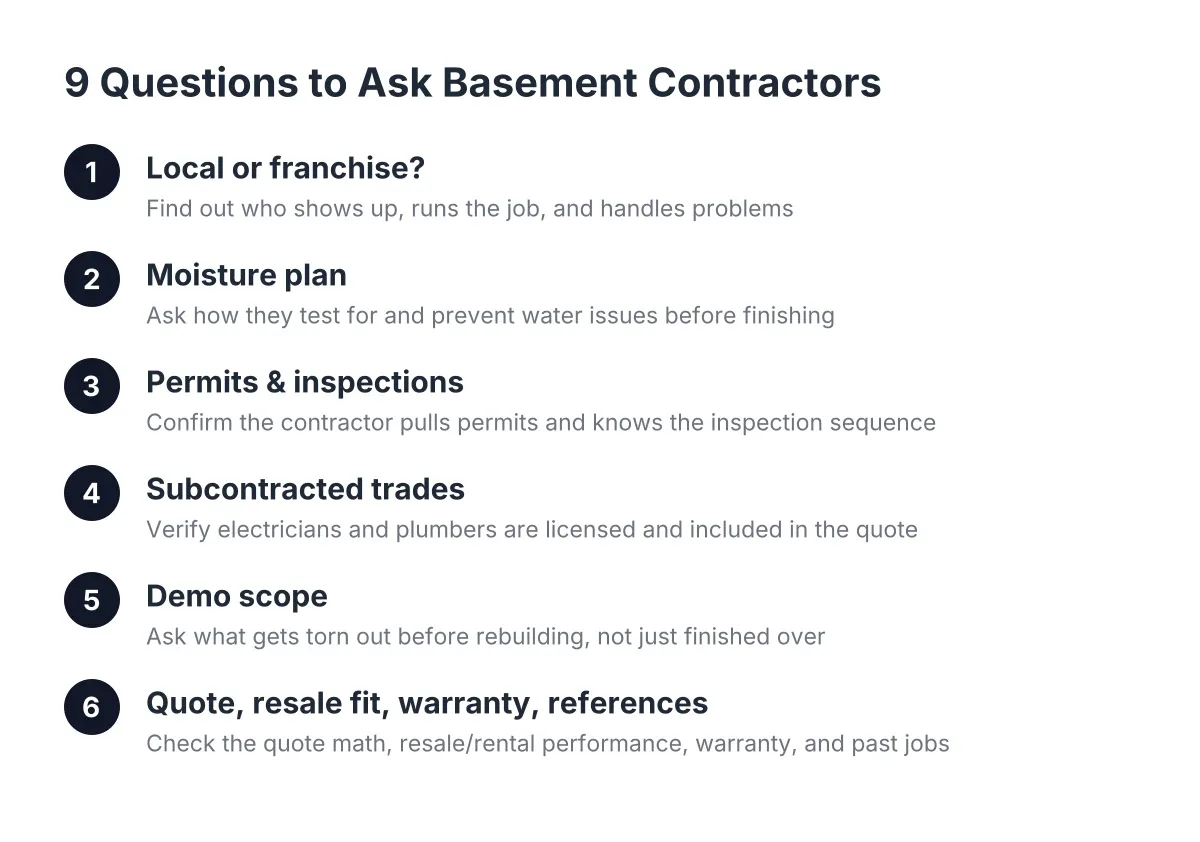
A fair quote for basement finishing or basement remodeling is specific. It names the scope room by room, lists allowances for flooring and fixtures, states who pulls permits, and explains how change orders work. A one-page number with "finish basement" as the entire scope is not a quote; it is an opening bid in a negotiation you will lose.
For rough context, Angi puts an average basement remodel between $30 and $75 per square foot, with high-end projects passing $120. Your number depends on what exists already, whether you are adding a basement bathroom, and how much tear-out the old work needs. Homeowners also underestimate trim; a finished basement can carry far more baseboard, casing, and paneling than a typical room, and a good quote accounts for that.
When you are comparing bids while hiring a basement contractor, use a checklist like this:
- Written scope that names each space, including the basement bathroom if you are adding one
- Line items or allowances for basement flooring, doors, trim, and fixtures
- Who pulls permits and schedules inspections, in writing
- A payment schedule tied to completed work, not the calendar
- How the existing framing and wiring will be assessed and documented
- What the warranty covers and for how long, in plain language
If one bid is dramatically lower than the others, find the missing line. It is usually permits, tear-out, or moisture work.
7. Weigh Basement Contractor vs. General Contractor for Your Specific Job
Choose based on the job, not the title. A straightforward finish of an open, dry basement suits either. A rescue job with unknown wiring, a planned basement bathroom, and a smarter basement layout favors whoever can show you similar completed projects in Minneapolis and explain their assessment process without a script.
Layout is a good test question for either type. A common mistake is leaving the space at the bottom of the stairs as unfinished storage and finishing only one side of the basement, which wastes the most usable area near the entry. Ask each bidder how they would lay out your space. The one who sketches basement ideas around your stairs, mechanicals, and windows, rather than reciting a package, is thinking about your house.
Also ask both types who does the actual work. Some general contractors sub out everything and visit weekly; some basement specialists self-perform framing and finish and sub only electrical and plumbing. Neither model is wrong, but you should know who will be in your house on a Tuesday.
8. Expect Honesty About Value, Not a Sales Pitch
A trustworthy contractor will tell you the financial truth: a finished basement rarely pays for itself at sale. The National Association of Realtors found homeowners recover about 64% of basement finishing costs at resale, which is among the better numbers for common projects but still not break-even. Returns swing widely by market, from 23% to 86% depending on region, according to Zonda / Journal of Light Construction.
So why finish it? Because you live there. The same NAR Remodeling Impact Report gave basement finishing a joy score of 9.5 out of 10 from homeowners. For a landlord, the math is different again; a legal finished basement with a conforming bedroom can raise rent enough to justify the cost across a small portfolio. A contractor who walks you through that math instead of promising your basement remodel will "pay for itself" is one you can trust with the harder conversations later.
One honest caveat: no article can tell you whether your specific framing or wiring is safe. That takes eyes on the job, and in the case of electrical work, a licensed electrician or a city inspector. Get that assessment before you spend a dollar on drywall.
The Bottom Line for 2026
The basement contractor general contractor choice matters less than the person's answers. In 2026, with plenty of franchise networks buying Minneapolis search ads, the real divide is local diagnosis versus standardized product. Hire whoever inspects before they quote, permits before they build, and explains what your half-finished basement needs in plain language. That is the contractor, whatever their title, who finishes basements right.
If you need basement finishing, Minneapolis Basement Finishing Pros can help.
Prefer to talk it through? Call (651) 758-8806 — a quick call is usually the fastest way to get a straight answer for your situation.