Basement Remodeling ROI: What a Finished Basement Returns in Minneapolis
Basement remodeling ROI on a finished basement is one of the first things Minneapolis homeowners ask about, and most of the answers online are national averages that tell you almost nothing about your house. This guide breaks down what a finished basement actually returns at resale here, what drives that number up or down, why the dollars-recovered figure is only half the story if you plan to live in the space for the next ten or twenty years, and how finished basement resale value depends on both the market and the condition of your space.
If you have been putting off finishing your basement because of a musty smell every spring, or because you are not sure the space will hold its value, you are asking the right questions. Moisture history matters to resale value more than most articles admit. A finished basement that stays dry is an asset. A finished basement hiding a water problem is a liability a home inspector will find. We will cover both sides.
What the Numbers Say About Basement Remodeling ROI and Finished Basement Resale Value
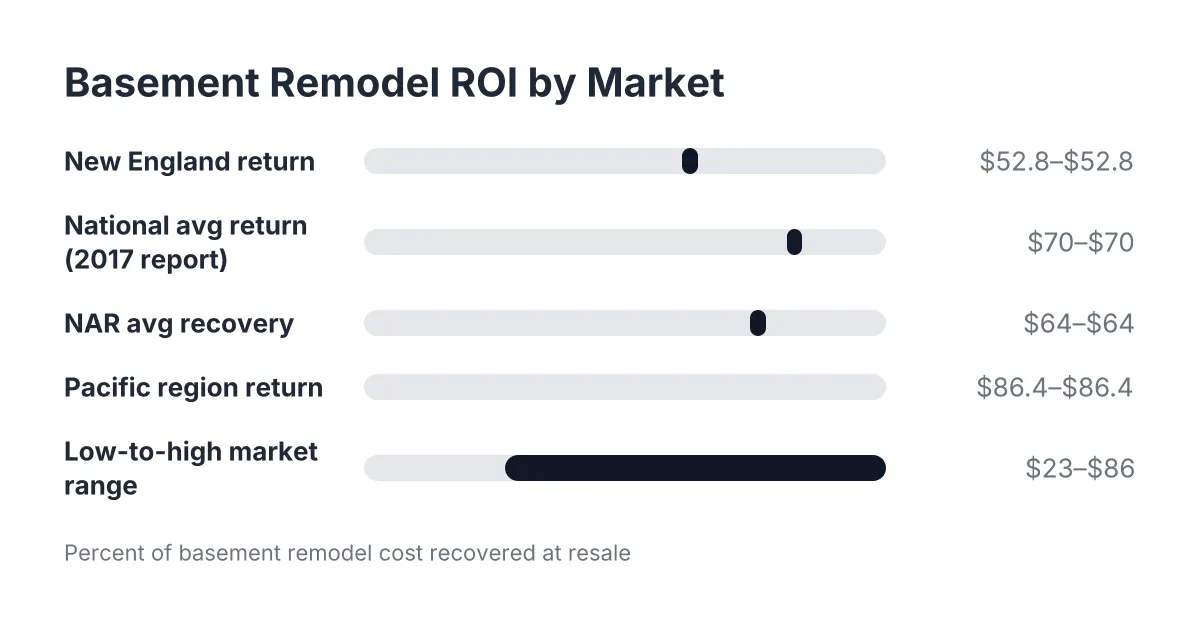
Finished basements recover a meaningful share of their cost at resale, but not all of it. The National Association of Realtors Remodeling Impact Report found that 64% of basement finishing costs are recovered when a home sells, one of the highest percentages among 20 popular home improvement projects studied. That is a solid return for a project you also get to live in.
However, the range across markets is wide. Basement remodel resale returns run from as little as 23% in some areas to 80 to 86% in others, according to Zonda / Journal of Light Construction. The 2017 Remodeling Cost vs. Value Report from Remodeling Magazine estimated a 70% national return, with the Pacific region at 86.4% and New England at only 52.8%. In other words, where you live changes the math a lot.
Minnesota sits in a favorable spot for one practical reason: winter. A basement here is not optional square footage the way it is in Texas or Arizona. In a climate with five months of real cold, finished lower-level space gets used daily, and buyers know it. Cold-climate markets tend to value finished basements more than warm-climate markets where outdoor living competes for the same dollars.
One more number worth knowing. Homeowners gave basement finishing a joy score of 9.5 out of 10 in the NAR Remodeling Impact Report. That matters because the resale percentage only captures what a future buyer pays you. It does not capture the years you spend using the space.
How Finished Basement Resale Value Compares to Other Home Improvement Returns
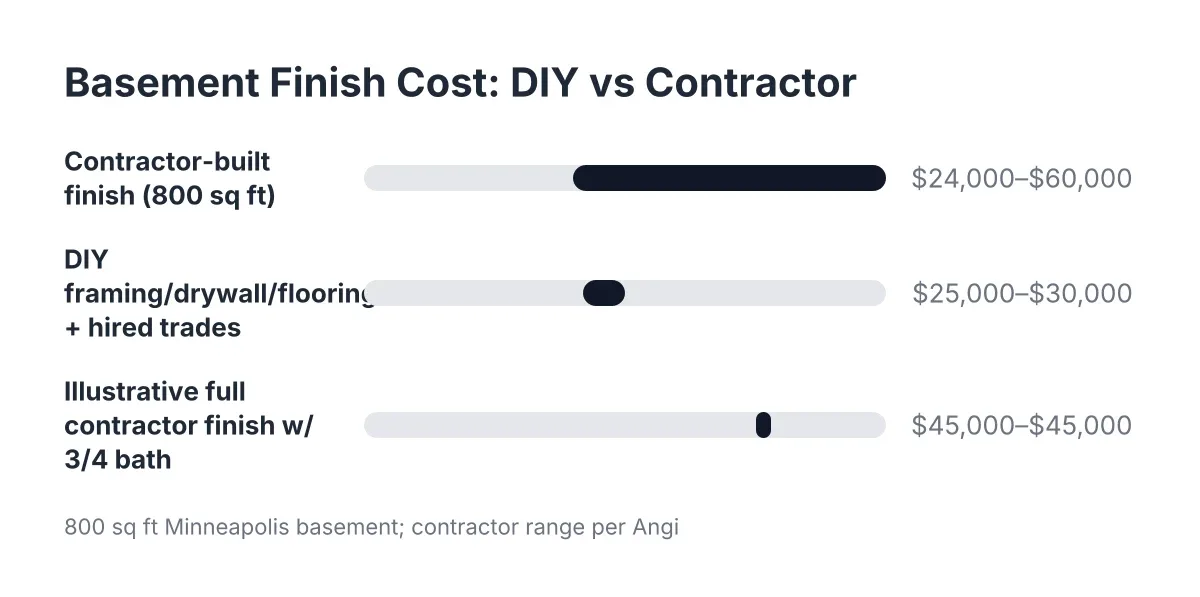
If you plan to stay in your home for five or more years, the recovered-cost percentage understates your return. Say a hypothetical couple in Minneapolis spends $55,000 finishing their basement into a guest suite with a bathroom so an aging parent can move in. At a 64% recovery rate, they would get back about $35,000 at sale. On paper, that looks like a $20,000 loss.
But run the real comparison. Adding the same bedroom, bathroom, and living area as a ground-level addition would cost two to three times as much, because an addition needs a foundation, a roof, and exterior walls. The basement already has all three. On a cost-per-usable-square-foot basis, finishing a basement is the cheapest way to add living space to a Minneapolis home, and that is before you count a decade of actual use.
Therefore, the honest way to think about basement remodeling ROI on a finished basement is in three layers:
- Resale recovery: the 50 to 70% of cost a buyer effectively pays you back at sale.
- Use value: the guest suite, media room, or hobby space you get for years before that sale ever happens.
- Avoided cost: what you did not spend on an addition, a bigger house, or assisted-living arrangements for a parent who can now live downstairs.
For long-tenure owners planning around retirement or a parent moving in, layers two and three usually dwarf layer one. The exception is an owner planning to sell within a year or two. In that case, a full remodel rarely pays for itself, and your money is better spent on cleanup, lighting, and fixing any moisture issue before listing.
The Moisture Question: Can a Damp Basement Ever Deliver Good ROI?
A basement with a moisture history can still deliver strong resale value, but only if the water problem is diagnosed and fixed before any framing goes up. Finishing over a damp basement does not hide the problem; it converts a cheap problem into an expensive one. Mold behind new drywall, buckled flooring, and a failed inspection at sale time will erase every dollar of return.
This is the part most ROI articles skip, and it is the part that matters most if you smell must every spring or found staining when you pulled up the old carpet. Buyers in Minneapolis are not naive about basements. A home inspector will run a moisture meter along the lower wall, note efflorescence on exposed foundation, and flag musty odor in the report. A finished basement that fails that test can subtract value from your sale instead of adding it.
The good news is that most damp basements are fixable, and most of the fixes cost far less than homeowners fear. Common causes, roughly in order of how often they show up:
- Gutters and grading. Downspouts dumping water at the foundation and soil sloping toward the house cause a large share of seasonal dampness. Fixes are often in the hundreds of dollars, not thousands.
- Vapor transmission through the slab. Older Minneapolis homes often have no vapor barrier under the concrete. A vapor barrier under a slab exists to block moisture moving up from the ground into the concrete, according to W. R. Meadows. Where there is none, flooring choice and a surface vapor retarder become the workaround.
- Hydrostatic pressure and seasonal groundwater. This is where interior drain tile and a sump pump earn their keep. It is also the fix that gets oversold to people who only needed gutter extensions.
A straightforward sequence protects you here. Diagnose first, fix the actual cause, then verify the basement stays dry through a wet season if the history is serious, and only then finish. Yes, that can mean waiting a few months. Waiting beats tearing out moldy drywall in year two. If your basement has had standing water more than once, bring in a professional to diagnose the source before you commit to a finishing budget; that assessment is worth more than any national ROI chart.
A contractor who starts talking about your layout before asking about your water history is not doing you a favor. The honest conversation starts at the foundation wall, not the paint samples.
What Actually Drives Finished Basement Value Up or Down
Not every finished basement returns the same percentage. Two projects with identical budgets can land very differently at resale. These are the factors that move the number in Minneapolis homes.
Ceiling height and natural light
Buyers walk downstairs and react in the first ten seconds. A basement with 7-foot-plus finished ceilings, decent window light, or a walkout reads as real living space and appraises like it. A 6-foot-4 ceiling with ductwork soffits everywhere reads as a converted cellar, no matter how nice the flooring is. Walkout basements carry the strongest resale value of all because they feel like a main floor.
A legal bedroom versus a bonus room
A finished basement with a code-compliant bedroom and proper egress adds a countable bedroom to your listing. That changes which buyers see your home in search filters and what comparable sales support. A big open room without egress is valuable space, but it appraises as "finished basement," not as a third or fourth bedroom. This single distinction often swings resale value more than any finish upgrade.
A basement bathroom
A basement bathroom is one of the strongest value-adds per dollar in a lower-level remodel. It makes a guest suite genuinely usable, supports multigenerational living, and removes the biggest practical objection buyers have to basement bedrooms. If rough-in plumbing already exists under your slab, the cost is moderate. If it does not, breaking concrete raises the budget, so get that answered during basement remodeling estimates in Minneapolis, not after demolition.
Mid-grade finishes, done consistently
The resale sweet spot in most Minneapolis neighborhoods is a consistent mid-grade finish: durable vinyl plank flooring rated for below-grade use, drywall ceilings where height allows, and trim and paint that match the upstairs. Consistency matters more than luxury. Matching paint colors and trim style across the whole lower level reads as higher-end than one showpiece wet bar next to builder-basic everything else.
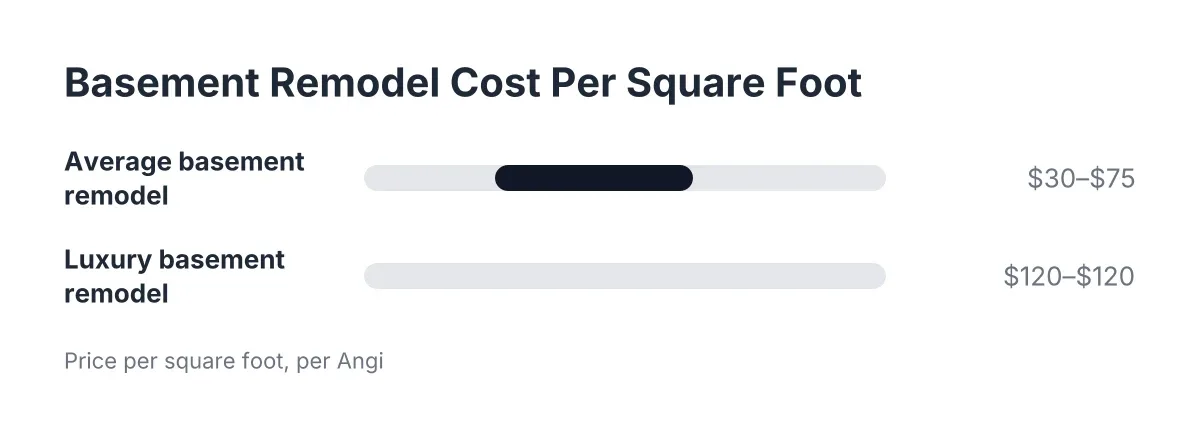
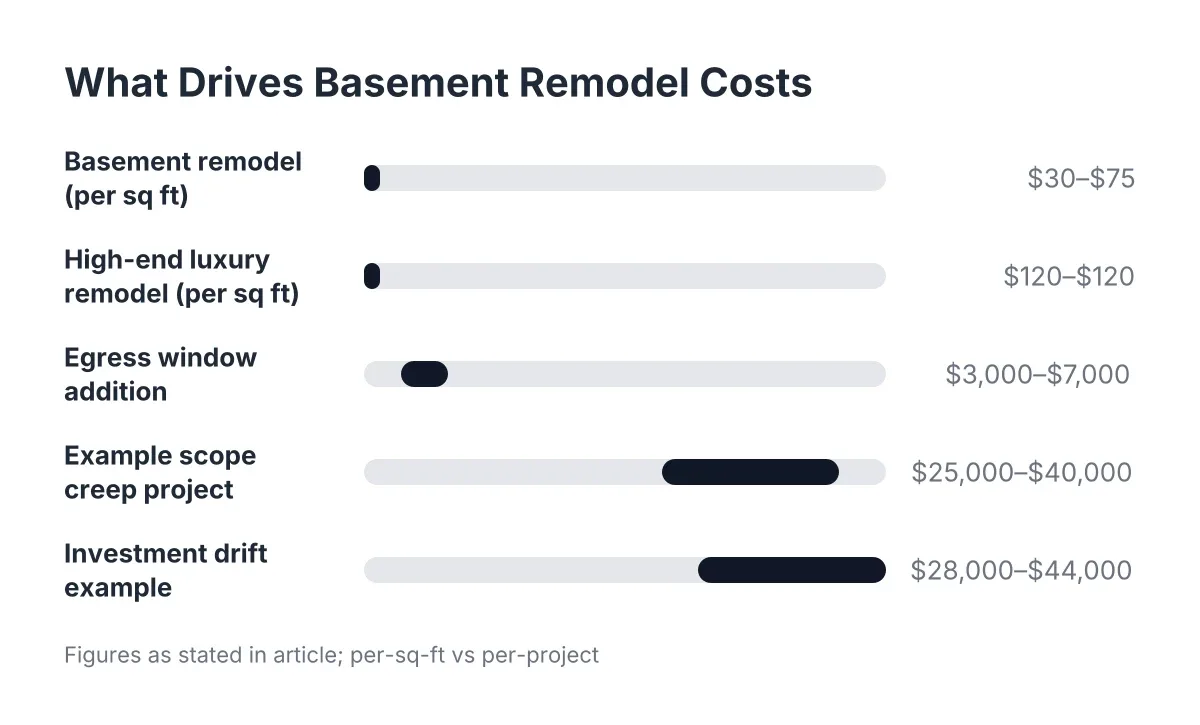
However, know that a luxury basement rarely returns luxury money. High-end remodels can run past $120 per square foot, according to Angi, while the average basement remodel costs between $30 and $75 per square foot. The dollars above the neighborhood norm come back at a lower rate. Build high-end because you want to live in it, not because a spreadsheet says it pays.
Permits and documentation
An unpermitted basement finish is a resale problem waiting to happen. Buyers' agents ask, appraisers check, and city records in Minneapolis are easy to pull. Permitted work with passed inspections, including the electrical rough-in and insulation inspections that happen early in a typical basement project, gives a future buyer confidence and protects your value. Keep the paperwork.
Cheap Versus Quality: Where Cutting Corners Kills the Return
Affordable basement remodeling is a legitimate goal; cheap basement remodeling is a different thing. The difference shows up at resale, and it shows up fastest in homes with any moisture history. Here is where saving money costs money:
- Skipping moisture prep. Carpet glued straight to a slab with no vapor consideration is the classic failure. It is also why you found what you found when you pulled up the old carpet.
- Wrong flooring for below grade. Solid hardwood and cheap laminate fail in basements. Vinyl plank, tile, and engineered products built for below-grade conditions hold up and hold value.
- Shortcut electrical. Exposed wiring done wrong is an inspection flag. Running standard Romex cable inside EMT conduit is against code in damp or wet locations, per the National Electrical Code. Proper wiring methods cost a little more and pass inspection the first time.
- Thin or missing trim work. Homeowners routinely underestimate how much baseboard, casing, and paneling a finished basement needs. Skimping here makes the whole space read unfinished, which is exactly the impression that drags down appraised value.
In addition, budget for the soft finishing. An empty finished basement with hard flooring and bare walls echoes, and it shows poorly. Rugs, furniture, and window treatments fix that for little money and make the space photograph well when you eventually list.
One timing note for 2026: if material prices are climbing sharply when you get bids, it can make sense to wait a season rather than start mid-spike. The basement is not going anywhere, and overpaying for lumber and drywall lowers your return on day one.
Running the ROI Math on Your Own Basement
You can estimate your own return in an afternoon with four numbers. This is where general basement remodeling cost figures become specific to your house instead of a national average.
- Finishable square footage. Measure the open area, excluding mechanical space you will leave unfinished. Suppose you have 800 usable square feet.
- A realistic project budget. Using the Angi range of $30 to $75 per square foot, 800 square feet pencils out between $24,000 and $60,000 depending on whether you add a bathroom, a bedroom with egress, or a wet bar. Firm this up with two or three written basement remodeling estimates from Minneapolis contractors, itemized by line.
- Expected resale recovery. Apply the NAR figure of 64% as a working midpoint. On a $45,000 project, that is about $28,800 back at sale.
- Your years of use. Divide the unrecovered portion by the years you expect to stay. In this hypothetical, $16,200 unrecovered over 12 years of ownership is $1,350 a year, about $112 a month, for a guest suite, a bathroom, and a family room you use every week of a Minnesota winter.
Framed that way, most long-tenure homeowners find the finished basement remodeling ROI case closes itself. The math only breaks down in two situations: a near-term sale with no time to use the space, or a moisture problem that was never actually solved. Fix the second one first, and the first one does not apply to you if you are planning to age in place.
The Bottom Line for Minneapolis Homeowners
A finished basement in Minneapolis recovers roughly two thirds of its cost at resale, ranks near the top of remodeling projects for value recovered, and scores higher in owner satisfaction than nearly anything else you can do to a house. The return gets better with a legal bedroom, a basement bathroom, consistent mid-grade finishes, permits on file, and most of all, a dry basement with the moisture source fixed at the root.
Start with the water question, get itemized estimates instead of vague per-square-foot guesses, and build the version of the space you will actually use. The resale number will take care of itself.
If you need basement finishing, Minneapolis Basement Finishing Pros can help.
Prefer to talk it through? Call (651) 758-8806 — a quick call is usually the fastest way to get a straight answer for your situation.